Portable Gantry Crane vs Semi Gantry Crane: Complete Comparison 2026
Portable gantry crane and semi gantry crane serve different industrial lifting needs, with portable models offering mobility and quick setup for light-duty applications (0.25-10 tons), while semi gantry crane systems provide higher capacity (1-70 tons) with one ground-supported leg and one building-mounted rail. According to industry data from 2024, approximately 45% of manufacturers choose portable gantry crane solutions for flexible workshop operations, whereas 35% opt for semi gantry crane configurations to maximize existing building infrastructure and reduce installation costs by 30-40% compared to full gantry systems.
Understanding Portable Gantry Crane Systems
What is a Portable Gantry Crane
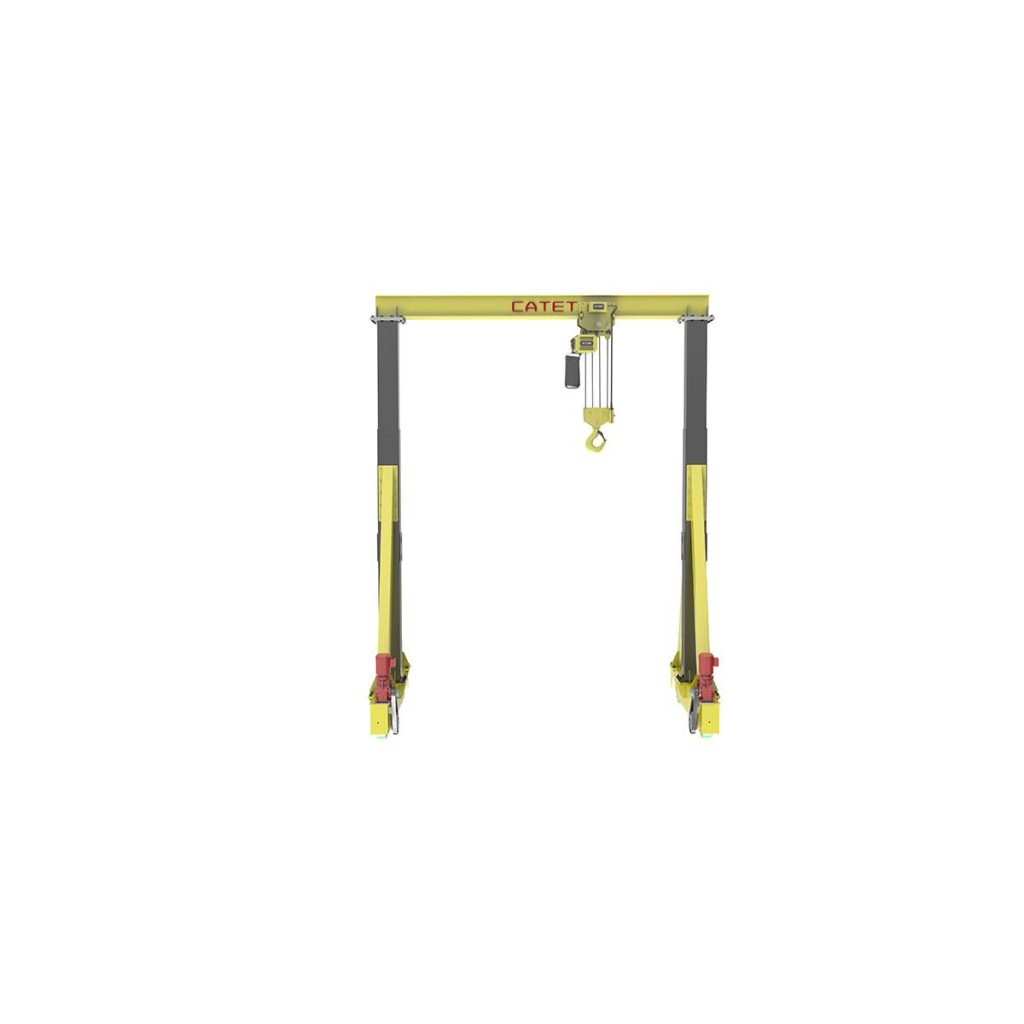
A portable gantry crane represents a lightweight, mobile lifting solution designed for easy transportation and quick assembly. These cranes feature a complete A-frame structure with two vertical legs connected by a horizontal beam. The entire assembly can be disassembled by one or two workers for relocation.
Modern portable gantry crane units utilize aluminum or steel construction. Aluminum models weigh as little as 116 pounds, enabling single-person component handling. Steel versions offer greater capacity while maintaining reasonable portability through modular design.
Furthermore, these cranes incorporate caster wheels or pneumatic tires for mobility. Standard phenolic casters suit smooth factory floors. Alternatively, inflatable pneumatic wheels handle rough surfaces like gravel and outdoor terrain effectively.
Key Features of Portable Gantry Cranes
Portable gantry crane systems deliver several distinctive features. First, adjustable height capability allows adaptation to varying lifting requirements. Height adjustments typically occur in 6-inch increments using spring-loaded locking pins.
These pins automatically engage when positioning holes align. Consequently, operators can adjust heights for specific lifts or uneven floors. Additionally, height adjustment enables passage through doorways during relocation.
Moreover, adjustable span features come standard on aluminum cranes. Steel models offer this as an optional upgrade. Adjustable spans allow shortening the crane for transport down narrow aisles.
Capacity Range and Specifications
Capacity ranges for portable gantry crane units typically span 0.25 to 10 tons. Light-duty models handle 250-500 kg (550-1,100 lbs) for small workshop tasks. Mid-range units lift 1-5 tons for general manufacturing applications.
Heavy-duty portable configurations reach 10-ton capacity. However, these require more robust construction and reduce portability advantages. Lifting heights generally range from 2-6 meters (6.5-20 feet) depending on model specifications.
Span lengths vary from 2-6 meters (6.5-20 feet) for most portable applications. Wider spans become impractical due to structural deflection and portability concerns.
| Portable Gantry Crane Type | Capacity Range | Typical Height | Best Applications |
|---|---|---|---|
| Aluminum Lightweight | 0.25-2 tons | 2-4 meters | Rooftop work, tight spaces |
| Steel Fixed Height | 1-5 tons | 2.5-5 meters | Workshop, maintenance |
| Steel Adjustable | 2-10 tons | 3-6 meters | Multi-purpose facilities |
| Telescoping | 1-2 tons | 3-4.5 meters | Variable height needs |
Understanding Semi Gantry Crane Systems
What is a Semi Gantry Crane
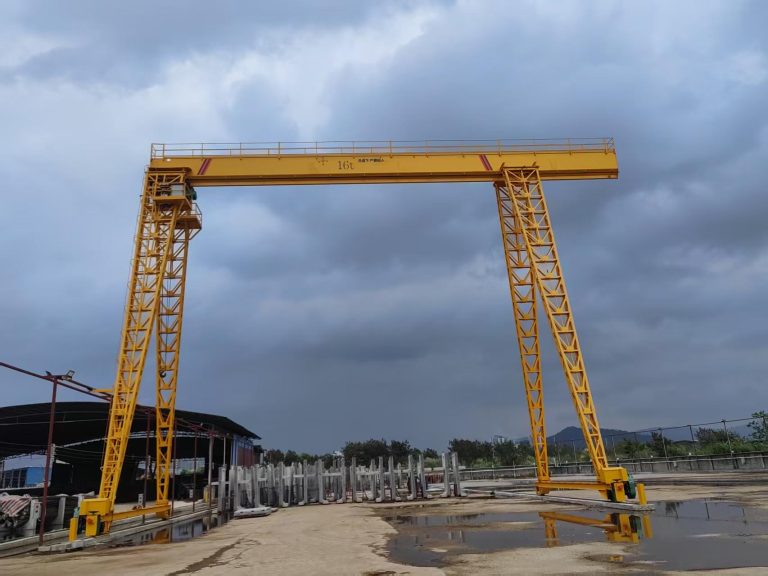
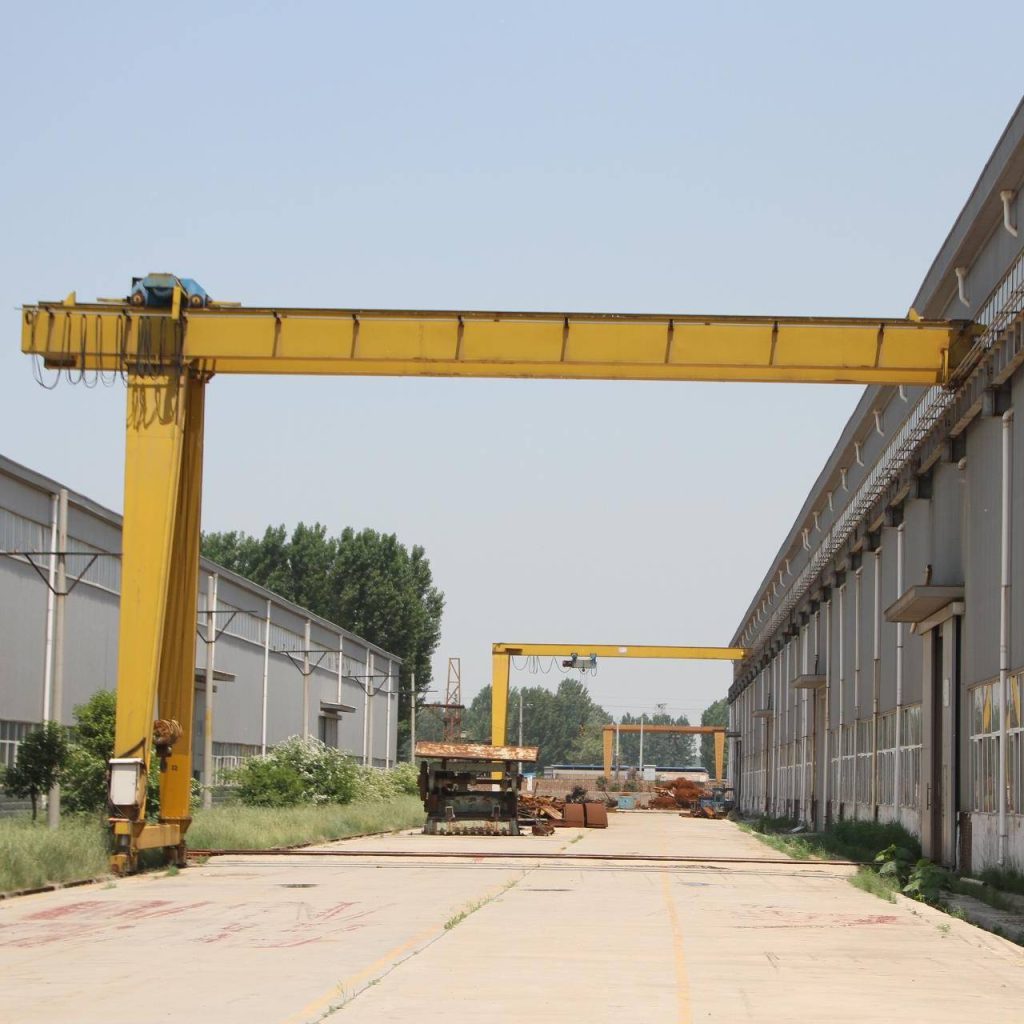
A semi gantry crane employs a hybrid support structure distinguishing it from full gantry designs. One end runs on ground-level tracks via a vertical leg support. The opposite end utilizes existing building structures for support.
This building-mounted end typically attaches to plant columns, walls, or fixed overhead runway beams. Therefore, semi gantry crane systems require less floor space than full gantry configurations. They also leverage existing infrastructure effectively.
The design proves particularly valuable in facilities with established building structures. Manufacturers can add lifting capability without extensive modifications. Additionally, the single-leg design optimizes usable floor space.
Structural Configurations
Semi gantry crane systems come in two primary structural variants. Single girder semi gantry crane models utilize one main horizontal beam. This design suits lighter loads and cost-conscious applications.
Capacities for single girder configurations typically range from 1-20 tons. The simplified structure reduces initial investment costs. Moreover, maintenance requirements remain minimal with fewer components.
In contrast, double girder semi gantry crane designs feature two parallel horizontal beams. This configuration provides enhanced stability and precision. Double girder models handle heavier loads from 5-70 tons.
Capacity and Coverage
Semi gantry crane capacity ranges significantly exceed portable alternatives. Light-duty models start at 1-3 tons for small workshops. Mid-range systems handle 5-20 tons for general manufacturing.
Heavy-duty configurations reach 32-70 tons for demanding industrial applications. Lifting heights extend up to 12 meters (40 feet) in specialized installations. Standard heights typically range 6-10 meters.
Span capabilities reach 35 meters (115 feet) maximum. However, most applications utilize 10-25 meter spans. The single-leg design allows longer spans than comparable portable gantry crane options.
Operating speeds vary based on application requirements. Lifting speeds typically range 2-8 meters per minute. Travel speeds reach 20-40 meters per minute for standard applications.
Structural Design Comparison
Frame Construction Differences
Portable gantry crane frames employ complete A-frame or rectangular structures. Both vertical legs rest on ground-level casters or wheels. The symmetric design distributes loads evenly across both supports.
This self-contained structure requires no building attachment. Consequently, portable units operate independently of facility infrastructure. The trade-off involves reduced maximum capacity and span limitations.
Conversely, semi gantry crane structures utilize asymmetric support arrangements. One leg runs on ground rails while the opposite end mounts to building structure. This hybrid approach reduces structural material requirements significantly.
Material and Weight Considerations
Material selection significantly impacts crane characteristics. Aluminum portable gantry crane models minimize weight for maximum portability. Extruded aluminum components enable easy one-person handling.
However, aluminum construction limits capacity to approximately 5 tons maximum. Steel portable models offer higher capacity but increase weight substantially. A 5-ton steel portable crane might weigh 2,000-3,000 kg.
Semi gantry crane systems typically employ steel construction throughout. The building-supported end eliminates one vertical leg reducing total steel requirements. Nevertheless, overall system weight exceeds portable alternatives significantly.
Mobility and Relocation
Portable gantry crane systems excel in mobility and relocation capability. Complete disassembly requires minimal time and basic tools. Components often fit through standard doorways and stairwells.
Common applications include rooftop installations where components ascend via ladders. Furthermore, portable units relocate between job sites efficiently. One or two workers complete disassembly, transport, and reassembly within hours.
In contrast, semi gantry crane installations remain relatively permanent. The building attachment requires professional installation and removal. Consequently, relocation proves impractical in most scenarios.
However, some semi gantry crane designs incorporate moveable building-mounted rails. This allows limited repositioning within the facility. The ground-level leg travels to new locations along extended track systems.
Capacity and Performance Analysis
Load Handling Capabilities
Portable gantry crane load capacity generally reaches 10 tons maximum. Most applications involve 1-5 ton loads in workshop and maintenance environments. The compact structure and portable design inherently limit maximum capacity.
Load handling precision varies based on hoist type. Manual chain hoists offer basic positioning control. Electric hoists with variable frequency drives enable precise load placement.
Conversely, semi gantry crane systems handle substantially heavier loads. Capacities from 10-70 tons suit demanding industrial applications. The building-supported structure and robust ground leg accommodate extreme loads safely.
Lifting Speed and Efficiency
Lifting speeds for portable gantry crane applications typically use manual or basic electric hoists. Manual chain hoists operate at 1-3 meters per minute. Electric chain hoists reach 2-8 meters per minute.
Bridge travel speeds remain limited in portable configurations. Most units require manual pushing for repositioning. Motorized travel options exist but reduce portability advantages.
Semi gantry crane installations employ professional-grade hoists and travel systems. Wire rope hoists achieve 3-12 meters per minute lifting speeds. Variable frequency drives enable precise speed control.
Travel mechanisms incorporate motorized drives for bridge movement. Speeds of 20-40 meters per minute enable efficient material transport. Advanced systems feature acceleration/deceleration controls preventing load swing.
Duty Cycle Classifications
Duty cycle requirements significantly influence crane selection. Portable gantry crane units typically suit light to moderate duty cycles. Intermittent operation with occasional lifts characterizes most portable applications.
CMAA classifications A1-A3 (infrequent service) apply to most portable scenarios. These cranes handle 2-5 lifts per hour at varied capacity percentages. Daily operating periods rarely exceed 2-4 hours.
Semi gantry crane systems accommodate moderate to heavy duty cycles. CMAA classifications A3-A5 (moderate to heavy service) apply depending on configuration. Production environments might perform 10-20 lifts per hour.
Continuous operation capabilities exist in heavy-duty semi gantry crane installations. Class A5 cranes support near-continuous use throughout production shifts. However, this requires premium components and enhanced maintenance.
Installation and Infrastructure Requirements
Portable Gantry Crane Setup
Portable gantry crane installation requires minimal infrastructure preparation. Operators need firm, level ground capable of supporting concentrated wheel loads. Concrete floors typically provide adequate support.
Assembly procedures involve connecting vertical legs to the horizontal beam. Bolted connections enable quick assembly without specialized tools. Most installations complete within 1-2 hours.
Ground surface requirements prove critical for safe operation. Uneven floors cause stability issues and potential tipping hazards. Furthermore, caster wheels require smooth surfaces for easy movement.
Semi Gantry Crane Installation Requirements
Semi gantry crane installation demands substantial infrastructure preparation. The ground-level track requires professional installation with precise alignment. Track tolerances typically specify ±3mm deviation over the entire length.
Foundation loads require engineering analysis. Concentrated loads from the ground leg might exceed building floor design capacity. Therefore, foundation reinforcement may prove necessary.
The building-mounted rail installation proves equally critical. Structural engineers must verify that existing building columns support additional loads. Calculations include vertical loads, horizontal side thrust, and dynamic impact forces.
Electrical and Control Systems
Portable gantry crane electrical requirements remain minimal for manual operation. Manual chain hoists require no electrical infrastructure. Electric chain hoists need standard 110V or 220V single-phase power.
Extension cords typically provide adequate power delivery for portable electric hoists. Control pendants with push-button stations offer basic operational control. Wireless remotes enhance operator convenience and safety.
Semi gantry crane electrical systems require professional installation and dedicated circuits. Three-phase power feeds the hoist and travel motors. Power delivery occurs through conductor bars, cable festoon, or cable reel systems.
Control systems range from basic pendant stations to sophisticated automation. Variable frequency drives enable precise speed control and soft starts. PLCs coordinate multiple motion axes in advanced installations.
Cost Analysis and Investment Comparison
Initial Purchase Costs
Portable gantry crane pricing varies significantly based on capacity and features. Lightweight aluminum models start around $1,500-3,000 for 0.5-1 ton capacity. Mid-range steel units cost $3,000-8,000 for 2-5 ton configurations.
Heavy-duty portable cranes reaching 10 tons command $8,000-15,000. Premium features including adjustable height, electric hoists, and motorized travel increase costs proportionally. Aluminum construction typically adds 30-50% to comparable steel models.
Semi gantry crane systems require substantially higher initial investment. Light-duty 3-5 ton single girder models start around $15,000-25,000 for basic configurations. Mid-range 10-20 ton systems cost $30,000-80,000 including installation.
Heavy-duty double girder configurations exceeding 30 tons reach $100,000-300,000+ depending on specifications. Custom features, automation, and specialized components increase costs further.
| Crane Type | Capacity | Basic Cost | With Installation | Premium Features |
|---|---|---|---|---|
| Portable Aluminum | 0.5-2 tons | $2,000-$5,000 | N/A | $3,000-$8,000 |
| Portable Steel | 2-5 tons | $4,000-$10,000 | N/A | $6,000-$15,000 |
| Semi Gantry Single | 3-10 tons | $15,000-$40,000 | $20,000-$55,000 | $30,000-$70,000 |
| Semi Gantry Double | 10-32 tons | $40,000-$120,000 | $55,000-$160,000 | $80,000-$250,000 |
Installation and Infrastructure Costs
Portable gantry crane installation costs remain minimal. Most users complete assembly internally without professional assistance. Therefore, installation expenses typically involve only labor time for existing staff.
External installation services cost $500-1,500 if required. This includes delivery, assembly, load testing, and operator training. Total installed cost rarely exceeds equipment purchase price by more than 10-15%.
Semi gantry crane installation represents significant additional investment. Professional rigging and installation services cost $5,000-20,000 for basic systems. Complex installations might reach $30,000-50,000 including structural modifications.
Foundation work and building reinforcement add substantial costs. Simple track installation costs $2,000-5,000. However, foundation reinforcement might require $10,000-30,000 in older facilities.
Building-mounted rail installation varies widely. Straightforward attachment to existing columns costs $3,000-8,000. Structural reinforcement and custom support systems increase this to $15,000-40,000.
Operational and Maintenance Expenses
Portable gantry crane operational costs remain low. Manual models require no electrical power consumption. Electric hoists consume minimal energy during intermittent operation.
Maintenance requirements prove minimal for portable configurations. Annual inspection costs $200-500 typically. Component replacement focuses on wear items like hoist chains, caster wheels, and brake linings.
Semi gantry crane operational expenses prove more substantial. Electrical power consumption varies based on duty cycle and capacity. A 10-ton crane operating 4 hours daily might consume 800-1,200 kWh monthly.
Maintenance costs for semi gantry crane systems range 2-4% of initial equipment cost annually. A $50,000 installation requires $1,000-2,000 yearly maintenance investment. This includes inspections, lubrication, and component replacement.
Major overhauls occur every 10-15 years depending on usage intensity. These might cost 15-30% of original equipment value. However, well-maintained systems achieve 20-25 year service lives.
Applications and Industry Uses
Portable Gantry Crane Applications
Portable gantry crane systems excel in temporary and mobile lifting scenarios. Maintenance operations represent primary applications. Technicians use portable units for equipment installation and removal in tight spaces.
Construction sites benefit from portable crane mobility. Workers transport components to different work areas as projects progress. Furthermore, rooftop installations utilize lightweight aluminum models that ascend via ladders.
Automotive repair shops employ portable gantry crane units for engine removal. The adjustable height accommodates different vehicle types. Additionally, the mobile design allows positioning over vehicles.
Small manufacturing facilities use portable configurations for flexible production support. Workers reposition cranes to different workstations as needed. This eliminates the expense of multiple fixed lifting points.
Semi Gantry Crane Applications
Semi gantry crane installations serve permanent production environments. Manufacturing facilities use these systems for continuous material handling operations. Assembly lines incorporate semi gantry designs for component positioning.
Warehouses implement semi gantry crane solutions for loading/unloading operations. The building-mounted rail runs along the warehouse perimeter. The ground leg travels through the facility center accessing storage areas.
Steel mills and metal fabrication shops rely on heavy-duty semi gantry crane configurations. These handle large steel coils, plates, and structural components. Capacities of 20-50 tons prove common in these applications.
Port operations sometimes employ semi gantry crane designs for specialized applications. Container handling in confined areas benefits from the space-saving asymmetric structure. The building support reduces ground-level obstruction.
Workshop and Maintenance Facilities
Workshop environments utilize both crane types for different purposes. Portable gantry crane units suit general maintenance tasks and equipment servicing. Technicians move these cranes to wherever work occurs.
Machine shops employ portable configurations for tooling changes and equipment repositioning. The mobility proves valuable when floor layouts change frequently. Additionally, portable units store compactly when not required.
Semi gantry crane installations suit shops with dedicated heavy lifting zones. These might include press installations, welding fixtures, or assembly stations. The permanent installation provides reliable lifting capability without floor obstruction.
Maintenance facilities in manufacturing plants often combine both approaches. Portable units handle light maintenance tasks throughout the facility. Semi gantry cranes provide heavy lifting capacity in dedicated maintenance bays.
Safety Considerations and Regulations
Portable Gantry Crane Safety
Portable gantry crane safety depends on proper setup and operation. Ground stability represents the primary concern. Uneven surfaces create tipping hazards during load handling operations.
Operators must verify caster wheels engage locking mechanisms before lifting. Furthermore, the crane should never move while loaded unless specifically rated for this operation. Most portable units prohibit movement under load.
Load capacity markings must remain clearly visible. Users should never exceed rated capacity including the weight of lifting accessories. Overloading portable structures risks catastrophic structural failure.
Wind loading affects outdoor portable crane operations. Lightweight aluminum units prove particularly vulnerable. Consequently, outdoor use in windy conditions requires additional precautions or operational restrictions.
Semi Gantry Crane Safety Requirements
Semi gantry crane safety involves more complex considerations. Professional installation ensures proper structural integrity. Building attachments must support all operational loads including dynamic forces.
OSHA regulations mandate regular inspections for industrial cranes. Daily visual checks by operators identify obvious defects. Monthly detailed inspections by maintenance personnel examine mechanical components.
Annual comprehensive inspections by certified crane inspectors prove mandatory. These evaluate structural integrity, mechanical systems, and electrical components. Documentation requirements include detailed inspection reports and corrective actions.
Operator training programs must address specific semi gantry crane characteristics. Training covers load capacity limits, operational procedures, and emergency responses. Operators require competency evaluation before independent operation.
Compliance Standards
Both crane types must comply with applicable safety standards. ASME B30.2 Safety Standard for Overhead and Gantry Cranes provides comprehensive requirements. This covers design, inspection, testing, maintenance, and operation.
European installations must meet FEM (Federation Europeenne de la Manutention) and ISO standards. These specify design criteria, safety factors, and testing procedures. CE marking indicates compliance with European safety directives.
Load testing proves mandatory before initial operation. Portable gantry crane units require testing to 125% of rated capacity. Semi gantry crane systems undergo similar procedures including static and dynamic testing.
Documentation requirements include manufacturer specifications, load capacity ratings, and maintenance records. Facilities must maintain inspection logs documenting all examinations and corrective actions. This proves essential for regulatory compliance and insurance coverage.
Selection Criteria and Decision Factors
Assessing Lifting Requirements
Capacity requirements drive initial crane selection. Calculate maximum anticipated loads including all lifting accessories. Therefore, add safety margins of 25-40% above calculated requirements.
Portable gantry crane capacity limitations might eliminate these from consideration. Loads exceeding 8-10 tons generally require semi gantry crane or alternative solutions. Additionally, frequent heavy lifting favors permanent installations.
Lifting height requirements affect feasibility. Portable units typically accommodate 4-6 meter heights maximum. Consequently, taller lifting requirements necessitate semi gantry crane configurations or overhead bridge cranes.
Evaluating Workspace Characteristics
Available floor space significantly impacts crane selection. Portable gantry crane units require temporary floor space during operation. However, they store compactly when not needed.
Facilities with dedicated lifting zones favor semi gantry crane installations. The permanent infrastructure doesn’t interfere with daily operations. Moreover, the single ground leg optimizes usable floor space.
Building structure capabilities determine semi gantry crane feasibility. Existing columns must support additional loads without reinforcement. Furthermore, ceiling height must accommodate the building-mounted rail system.
Frequency and Duty Cycle Analysis
Operational frequency influences cost-effectiveness calculations. Occasional lifting tasks suit portable gantry crane economics. The lower initial investment justifies selection for intermittent use.
Frequent daily lifting operations favor semi gantry crane installations. The higher capacity and durability justify increased investment. Additionally, operational efficiency improves with permanent infrastructure.
Duty cycle intensity affects service life expectations. Portable units suit light duty cycles with occasional use. Continuous heavy-duty operation requires robust semi gantry crane configurations designed for intensive service.
Budget and Total Cost Evaluation
Initial budget constraints might dictate portable gantry crane selection. The lower equipment cost suits limited capital availability. Moreover, minimal installation expense enables immediate deployment.
However, total cost of ownership calculations favor semi gantry crane systems in many scenarios. The longer service life and lower per-lift operational cost justify higher initial investment for frequent use.
Consider opportunity costs of operational efficiency. Portable units require manual positioning and slower operation. Therefore, labor costs accumulate over time with portable configurations.
Semi gantry crane automation and efficiency reduce labor requirements. The higher productivity might justify premium pricing in production environments. Additionally, improved safety reduces accident-related costs.
Maintenance and Service Life Expectations
Portable Gantry Crane Maintenance
Portable gantry crane maintenance requirements remain straightforward. Monthly visual inspections check for structural damage, caster wear, and connection integrity. Operators can perform these inspections without specialized training.
Lubrication needs prove minimal in portable configurations. Caster wheels require periodic lubrication every 3-6 months. Hoist maintenance follows manufacturer specifications typically involving annual chain or cable inspection.
Component replacement focuses on wear items. Caster wheels typically last 2-5 years depending on usage intensity. Hoist chains require replacement every 3-7 years. Structural components rarely need replacement with proper use.
Service life for portable gantry crane units averages 10-15 years with moderate use. Aluminum models might achieve 15-20 years in controlled environments. Conversely, intensive outdoor use reduces expected life to 8-12 years.
Semi Gantry Crane Maintenance Programs
Semi gantry crane maintenance demands systematic programs. Daily operator inspections check for unusual noises, vibration, or operational irregularities. These brief checks identify developing issues before failures occur.
Monthly detailed inspections examine mechanical and electrical systems. Qualified maintenance personnel inspect wire ropes, brakes, limit switches, and travel mechanisms. Furthermore, they check for structural cracks or deformation.
Quarterly lubrication schedules maintain mechanical components. Wire ropes require regular application of appropriate lubricants. Additionally, gearboxes, bearings, and wheel assemblies need periodic service.
Annual comprehensive inspections by certified specialists prove mandatory. These evaluate all structural, mechanical, and electrical systems. Moreover, load testing verifies continued safe operation.
Component Lifecycle Management
Critical components require proactive replacement schedules. Wire ropes typically last 3-5 years in moderate service. However, intensive use or harsh environments reduce this to 1-3 years.
Brake linings require replacement every 2-4 years depending on duty cycle. Electrical contacts and brushes need service annually in active installations. Consequently, maintenance budgets must account for these periodic expenses.
Major overhauls occur every 10-15 years for semi gantry crane systems. These include structural inspection, bearing replacement, and control system updates. Total overhaul costs might reach 25-35% of original equipment value.
Portable gantry crane major service involves primarily hoist replacement. After 10-15 years, replacing the entire hoist unit often proves more economical than refurbishment. This might cost $1,500-4,000 depending on capacity.
Future Trends and Technology Developments
Portable Gantry Crane Innovations
Lightweight materials continue advancing portable gantry crane capabilities. Carbon fiber composites reduce weight while maintaining strength. Consequently, higher capacities become achievable in portable configurations.
Modular quick-connect systems improve assembly efficiency. Tool-free connections enable faster setup and disassembly. Moreover, these systems ensure consistent assembly quality reducing human error.
Battery-powered electric hoists eliminate cord management issues. Lithium-ion batteries provide 4-8 hours of operation per charge. Therefore, wireless operation improves mobility and flexibility.
Smart load monitoring systems integrate into portable designs. Digital displays show current load percentage preventing overloading. Furthermore, data logging tracks usage patterns for maintenance planning.
Semi Gantry Crane Advancements
Automation technologies transform semi gantry crane operations. Automated positioning systems enable precise load placement without manual control. Moreover, these systems improve productivity and reduce operator fatigue.
Collision avoidance systems prevent accidents in multi-crane environments. Sensors detect approaching obstacles and automatically stop crane motion. Consequently, damage prevention improves operational efficiency.
Remote monitoring capabilities enable predictive maintenance. Sensors track vibration, temperature, and operational parameters. Furthermore, data analytics identify developing issues before failures occur.
Energy efficiency improvements reduce operational costs. Regenerative braking systems return energy to electrical supplies. Additionally, LED lighting and efficient motors minimize power consumption.
Integration and Industry 4.0
IoT connectivity enables comprehensive equipment management. Cloud-based systems track multiple crane operations across facilities. Therefore, management gains visibility into equipment utilization and performance.
Predictive maintenance algorithms analyze operational data. Machine learning identifies patterns indicating potential failures. Consequently, maintenance schedules optimize based on actual equipment condition rather than fixed intervals.
Digital twin technology simulates crane operations virtually. Engineers optimize processes and identify bottlenecks before implementation. Moreover, digital twins support operator training in safe virtual environments.
Augmented reality applications assist maintenance personnel. AR headsets overlay maintenance procedures and diagnostic information. Therefore, service efficiency improves while reducing expertise requirements.
Frequently Asked Questions
Main Differences Between Crane Types
What are the main differences between portable gantry crane and semi gantry crane?
The primary differences involve structure, capacity, and application suitability. Portable gantry crane systems feature complete A-frame structures with both legs on ground-level wheels or casters. This enables mobility and relocation capabilities.
Conversely, semi gantry crane configurations utilize asymmetric support with one ground leg and one building-mounted rail. Capacity differences prove significant with portable units typically limited to 10 tons maximum. In contrast, semi gantry systems handle 1-70 tons.
Portability represents the defining characteristic of portable gantry cranes. Users can disassemble and relocate these cranes between job sites or work areas. Semi gantry installations remain essentially permanent structures.
Cost structures differ substantially between types. Portable gantry crane units cost $2,000-15,000 typically. Semi gantry crane systems range $15,000-300,000+ including installation. Furthermore, semi gantry installations require professional setup and structural modifications.
Application suitability varies accordingly. Portable units excel in temporary lifting tasks, mobile operations, and flexible workshop environments. Semi gantry cranes suit permanent production facilities requiring consistent heavy lifting capacity.
Portable Gantry Crane Weight Capacity
What is the maximum weight a portable gantry crane can lift?
Maximum weight capacity for portable gantry crane systems typically reaches 10 tons (20,000 lbs). However, most portable applications involve lighter loads. Aluminum portable gantry crane models generally limit to 5 tons maximum capacity.
This limitation stems from structural constraints of portable designs. Higher capacities require heavier construction that compromises portability advantages. Therefore, manufacturers balance capacity against mobility and ease of handling.
Common capacity ranges suit different applications effectively. Lightweight models handling 0.25-1 ton serve rooftop work and tight access areas. Mid-range 2-5 ton units suit general workshop and maintenance tasks.
Heavy-duty portable configurations reaching 8-10 tons require steel construction. These prove less portable but still offer relocation advantages over permanent installations. Additionally, they provide adequate capacity for many industrial maintenance applications.
Exceeding rated capacity creates serious safety hazards. Portable gantry crane structures might fail catastrophically under overload conditions. Consequently, users must account for all load components including lifting accessories, spreader bars, and fixtures.
Installation Time Comparison
How long does it take to install each crane type?
Installation timeframes differ dramatically between portable gantry crane and semi gantry crane systems. Portable units typically require 30 minutes to 2 hours for complete assembly. One or two workers accomplish setup without specialized equipment.
The process involves connecting vertical legs to the horizontal beam using bolted connections. Subsequently, operators install caster wheels or support feet. Finally, load testing verifies proper assembly before operational use.
Semi gantry crane installation demands substantially more time and resources. Basic installations require 2-5 days minimum for professional rigging teams. This includes ground track installation, structural attachments, electrical connection, and load testing.
Complex installations might extend to 2-4 weeks. This timeline accommodates foundation work, structural reinforcement, and custom modifications. Furthermore, coordination with other trades extends overall project duration.
Engineering and planning phases precede physical installation. Structural analysis might require 2-4 weeks. Permit acquisition adds additional time depending on local requirements.
Conversely, portable gantry crane deployment requires no advance planning. Users assemble these systems immediately upon delivery. Therefore, operational capability begins within hours rather than weeks or months.
Cost-Effectiveness Analysis
Which crane type is more cost-effective for small operations?
Cost-effectiveness depends on operational requirements and usage frequency. Portable gantry crane systems generally prove more economical for small operations with occasional lifting needs. The lower initial investment suits limited budgets.
For operations requiring 2-5 lifts daily, portable units deliver adequate capability. Initial equipment costs of $3,000-10,000 provide years of reliable service. Moreover, minimal maintenance and operational expenses keep total ownership costs low.
Semi gantry crane systems justify investment through operational efficiency. Facilities performing 10+ lifts daily benefit from permanent infrastructure. Although initial costs reach $20,000-60,000+, productivity improvements offset this investment.
Calculate cost per lift over expected service life. A portable gantry crane costing $5,000 with 10-year life handling 500 lifts annually yields $1 per lift. A semi gantry crane costing $40,000 with 20-year life and 2,000 lifts annually yields $1 per lift.
However, this analysis ignores operational efficiency differences. Semi gantry crane installations enable faster cycle times and reduced labor. Therefore, high-volume operations achieve lower effective cost per lift despite higher initial investment.
Small operations with limited budgets typically select portable gantry crane solutions initially. Subsequently, they might upgrade to semi gantry crane systems as business grows and lifting requirements intensify.
Outdoor Use Suitability
Can both crane types operate outdoors effectively?
Both portable gantry crane and semi gantry crane systems accommodate outdoor operation with appropriate specifications. However, environmental protection requirements differ significantly between types.
Portable gantry crane outdoor use requires weather-resistant construction. Powder-coated steel or aluminum resists corrosion in moderate climates. Stainless steel components suit harsh coastal environments.
Caster wheels must handle outdoor terrain. Standard phenolic casters suit smooth concrete surfaces. Pneumatic tires enable operation on gravel, asphalt, and uneven ground.
Wind loading affects lightweight portable units significantly. Aluminum cranes require tie-down provisions in windy conditions. Furthermore, operators should cease operations during high winds exceeding manufacturer specifications.
Semi gantry crane outdoor installations incorporate comprehensive weather protection. Corrosion-resistant coatings or galvanizing protect structural steel. Electrical components require NEMA 4 or IP65 minimum ratings.
Storm anchoring devices prevent crane displacement during extreme weather. These engage automatically when wind speeds exceed safe operating limits. Additionally, building-mounted rails include drainage provisions preventing water accumulation.
Temperature extremes affect both systems. Outdoor specifications typically accommodate -20°C to +50°C operating ranges. Specialized applications might require -40°C to +60°C ratings with enhanced lubrication systems.
Space Requirements
How much space does each crane type require?
Space requirements vary significantly between portable gantry crane and semi gantry crane configurations. Portable units require temporary operational space but store compactly when not in use.
A typical 5-ton portable gantry crane occupies approximately 4m x 3m footprint during operation. Height requirements include crane height plus lifting height plus load dimensions. Total overhead clearance might reach 5-7 meters.
Storage requirements prove minimal for portable configurations. Disassembled components stack in approximately 2m x 1m x 1m space. Consequently, facilities without dedicated crane areas accommodate these systems effectively.
Semi gantry crane space requirements involve permanent infrastructure. The ground-level track consumes floor space along its entire length. Track width typically measures 1.5-3 meters depending on capacity.
The building-mounted rail requires no floor space but affects ceiling height. Mounting height plus crane height plus lifting height determines total ceiling requirement. This might reach 8-12 meters in industrial applications.
Operational envelope includes the entire area the crane can access. A semi gantry crane with 15-meter span and 30-meter rail length covers 450 square meters. However, the asymmetric design optimizes this space better than full gantry alternatives.
Lifespan Expectations
What is the expected lifespan of each crane type?
Expected lifespan varies based on construction quality, usage intensity, and maintenance practices. Portable gantry crane systems typically achieve 10-15 years with moderate use. Aluminum models in controlled environments might reach 15-20 years.
Intensive outdoor operation reduces portable crane life to 8-12 years. Corrosion, UV exposure, and mechanical wear accelerate degradation. Regular maintenance and protective treatments extend service life significantly.
Component replacement extends overall system life. After 10 years, users might replace hoists while retaining structural components. This approach proves cost-effective when structures remain sound.
Semi gantry crane installations achieve 20-25 years with proper maintenance. Heavy-duty double girder configurations might exceed 30 years in controlled environments. Conversely, continuous heavy-duty service in harsh conditions reduces this to 15-20 years.
Major overhauls extend semi gantry crane service life significantly. Comprehensive refurbishment at 15-year intervals can double effective lifespan. This includes structural inspection, bearing replacement, and electrical system updates.
Component lifecycle varies within the overall system. Wire ropes require replacement every 3-5 years typically. Brake linings last 2-4 years depending on duty cycle. However, main structural components endure for the crane’s entire service life.
Investment recovery calculations should consider expected lifespan. A portable gantry crane costing $8,000 with 12-year life yields $667 annual depreciation. A semi gantry crane costing $50,000 with 20-year life produces $2,500 annual depreciation.
Nevertheless, productivity and capacity differences affect true economic comparison. High-capacity semi gantry systems enable operations impossible with portable alternatives. Therefore, lifespan considerations alone don’t determine optimal selection.
Mobility and Relocation
How easy is it to relocate each crane type?
Relocation ease represents a fundamental difference between portable gantry crane and semi gantry crane systems. Portable units excel in mobility and relocation capability by design.
Complete portable gantry crane disassembly requires 30-60 minutes typically. Two workers with basic hand tools accomplish this task. Components separate into manageable pieces weighing 50-200 lbs each.
Transportation proves straightforward for portable configurations. Standard pickup trucks or vans accommodate disassembled components. Consequently, relocation between job sites occurs easily and economically.
Reassembly at new locations requires similar timeframes. Workers level the crane, connect components, and verify proper assembly. Subsequently, load testing confirms safe operation before resuming work.
Semi gantry crane relocation proves impractical in most scenarios. The building attachment requires professional disconnection and removal. Ground-level tracks must be disconnected and potentially removed.
Complete semi gantry crane relocation might cost $15,000-40,000 including disassembly, transport, and reinstallation. This approaches or exceeds the cost of smaller new installations. Therefore, semi gantry systems remain at original locations throughout service life.
However, some semi gantry crane designs accommodate limited repositioning. Extended building-mounted rails allow travel beyond initial installation zones. The ground leg relocates to new positions accessing different facility areas.
Operator Training Requirements
What training is required to operate each crane type safely?
Operator training requirements differ based on crane complexity and regulatory context. Portable gantry crane operations generally require less extensive training than semi gantry systems.
Basic portable gantry crane operation training spans 2-4 hours typically. This covers assembly procedures, capacity limitations, and safe operating practices. Additionally, operators learn proper load attachment and movement techniques.
Manual hoist operation requires understanding mechanical advantage and chain management. Electric hoist training addresses control functions and emergency procedures. Furthermore, operators must recognize hazardous conditions requiring work stoppage.
Semi gantry crane operator training demands more comprehensive programs. OSHA recommends 8-16 hours combining classroom instruction and practical exercises. This addresses equipment capabilities, load dynamics, and safety protocols.
Formal certification programs exist through organizations like NCCCO (National Commission for the Certification of Crane Operators). While not universally mandated, many employers require certification for semi gantry crane operators.
Training topics include load capacity calculations, rigging techniques, hand signals, and emergency procedures. Moreover, operators learn to recognize maintenance issues and hazardous conditions. Competency evaluation ensures operators demonstrate safe practices before independent operation.
Refresher training occurs annually in many facilities. This reinforces safe practices and introduces operators to equipment modifications. Additionally, refresher sessions address lessons learned from incidents or near-misses.
Power and Energy Requirements
What are the power requirements for each crane type?
Power requirements vary significantly based on hoist type and operational features. Portable gantry crane systems offer both manual and electric options accommodating different power availability scenarios.
Manual portable gantry cranes require no electrical power. Chain hoists operate through mechanical advantage using hand chains. Consequently, these suit remote locations or areas without electrical infrastructure.
Electric portable gantry crane hoists typically operate on standard single-phase power. Common voltages include 110V, 120V, or 220V depending on regional standards. Power consumption ranges from 0.5-3 kW for typical capacities.
Extension cords often provide adequate power delivery for portable electric hoists. However, cord specifications must match hoist electrical requirements. Undersized cords cause voltage drop affecting hoist performance and safety.
Semi gantry crane systems require professional electrical installations with dedicated circuits. Three-phase power feeds hoist motors and travel drives. Common voltages include 208V, 220V, 380V, 440V, or 480V.
Power consumption varies based on capacity and duty cycle. A 10-ton semi gantry crane might draw 15-30 kW during lifting operations. Travel motors add 2-8 kW depending on speed and load.
Energy-efficient variable frequency drives reduce overall power consumption significantly. These systems capture regenerative braking energy returning it to electrical supplies. Consequently, operational costs decrease by 20-35% compared to conventional controls.
Customization Options
Can these cranes be customized for specific applications?
Both portable gantry crane and semi gantry crane systems accommodate customization, though options differ significantly. Portable configurations offer limited customization due to standardized modular designs.
Common portable gantry crane customizations include adjustable height and span features. Users specify maximum dimensions accommodating their typical applications. Subsequently, cranes adjust within these ranges for specific lifts.
Caster wheel selections customize portable units for different surfaces. Standard phenolic wheels suit smooth factory floors. Alternatively, pneumatic tires handle outdoor or rough terrain applications. Locking mechanisms prevent unintended movement during operation.
Hoist options provide additional customization. Manual chain hoists suit occasional use and power-free operation. Electric chain hoists improve efficiency for frequent lifting. Wire rope hoists accommodate higher speeds and capacities.
Semi gantry crane customization proves far more extensive. Engineers design systems meeting exact operational requirements. Consequently, specifications address capacity, span, height, and speed parameters precisely.
Specialized features include rotating hooks for load orientation, weighing systems for load monitoring, and automated positioning for precise placement. Furthermore, environmental protection accommodates extreme temperatures, corrosive atmospheres, or explosive environments.
Custom spreader beams and lifting attachments integrate with semi gantry crane systems. These handle unique load geometries or special handling requirements. Moreover, multi-hoist configurations enable tandem lifting of extremely long loads.
Control system customization ranges from basic pendant stations to fully automated operation. PLC integration enables coordination with production equipment. Additionally, remote monitoring systems track performance metrics for operational optimization.
Conclusion
Selecting between portable gantry crane and semi gantry crane configurations requires careful analysis of operational requirements, budget constraints, and facility characteristics. Portable systems excel in flexibility, mobility, and low initial investment, making them ideal for occasional lifting tasks, temporary installations, and small workshops. Their capacity limitations (typically under 10 tons) and manual operation suit light-duty applications where relocation capability outweighs automation benefits.
Conversely, semi gantry crane installations deliver superior capacity (1-70 tons), operational efficiency, and long-term reliability for permanent production environments. The asymmetric structure optimizes building space utilization while leveraging existing infrastructure. Although initial investment proves substantially higher, facilities with frequent heavy lifting requirements achieve favorable return on investment through improved productivity and reduced labor costs. Therefore, assess your specific needs comprehensively—considering not only current requirements but also future growth—to determine which crane type aligns best with your operational and financial objectives.