Single Girder Overhead Crane: Complete Guide for Industrial Applications | 2025
A single girder overhead crane represents one of the most economical and efficient lifting solutions for modern industrial facilities. Moreover, this versatile equipment serves manufacturing plants, warehouses, and assembly operations worldwide. Industry data shows that single girder designs cost 20-30% less than comparable double girder systems. Additionally, they provide reliable material handling with spans up to 120 feet. Understanding the capabilities, specifications, and applications of single girder overhead cranes helps facility managers make informed equipment decisions. Consequently, this comprehensive guide explores everything you need to know about these essential lifting systems.
Understanding Single Girder Overhead Crane Design
Basic Structural Configuration
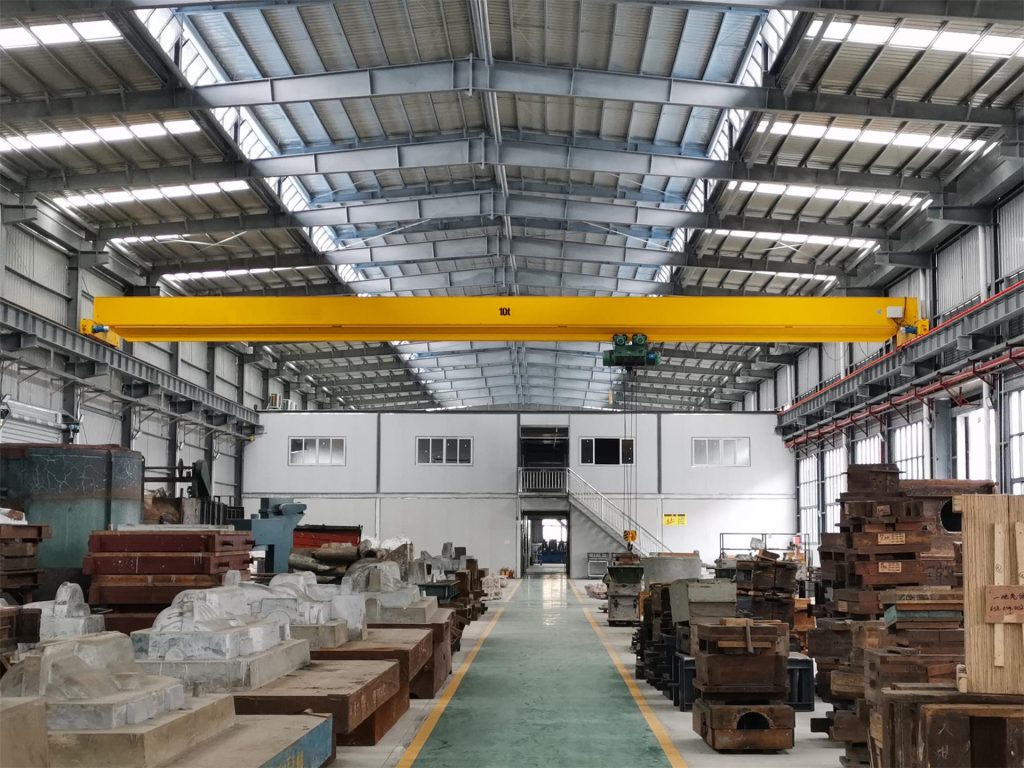
The single girder overhead crane features a streamlined design with one main load-bearing beam. This beam spans the width of the facility bay. Furthermore, an electric hoist travels along the bottom flange of the girder. The hoist typically uses wire rope for capacities from 1 to 20 tons. Alternatively, chain hoists serve applications under 5 tons. End trucks mounted on each side of the girder contain wheels. These wheels run on elevated runway beams mounted on building columns. Additionally, drive motors enable bridge travel perpendicular to the girder span.
According to CMAA Specification #74, single girder cranes typically use wide flange structural beams for capacities under 10 tons. Box girder construction becomes necessary for spans exceeding 60 feet. Moreover, capacities greater than 10 tons also require box girder designs. The girder must support combined dead load, live load, and impact forces. Specifically, impact forces range from 25% to 50% of lifted load depending on duty cycle.
Design Advantages and Benefits
This configuration offers several distinct advantages over double girder designs. First, the simplified structure reduces material costs by approximately $8,000 to $15,000 for typical 10-ton systems. Moreover, installation time decreases from 5-7 days to just 3-5 days. Furthermore, building height requirements are 18 to 24 inches lower. The hoist hangs below the girder rather than riding on top. Consequently, facilities with ceiling heights of 16 to 20 feet can still implement effective crane systems.
Additionally, maintenance requirements decrease significantly. Industry studies show single girder cranes require 30-40% less annual maintenance than double girder equivalents. Fewer components mean fewer potential failure points. The simplified trolley design reduces complexity. Therefore, routine inspections complete faster. One maintenance technician can service a single girder crane in 4-6 hours. In contrast, double girder systems require 8-12 hours.
Standard Capacity and Span Ranges
Single girder overhead crane systems handle loads from 0.5 to 32 tons depending on configuration. Standard capacities include 1, 2, 3, 5, 8, 10, 15, and 20-ton ratings. Meanwhile, spans range from 10 feet to 120 feet for specialized designs. However, typical installations use 15 to 60-foot spans. Lifting heights vary from 10 to 98 feet based on hoist selection and facility requirements.
Most manufacturers limit standard single girder designs to spans under 60 feet. This aligns with available rolled steel section lengths. Spans exceeding 60 feet require spliced girders or box girder construction. The duty cycle classification ranges from A3 to A5 per CMAA standards.
- Class A3 serves light service with 2-5 lifts per hour.
- Class A4 handles moderate service with 5-10 lifts hourly.
- Class A5 accommodates heavy service exceeding 10 lifts per hour. Therefore, this covers light to medium-duty industrial applications effectively.
Key Components and Operating Principles
Main Girder Structure Design
The main girder forms the structural backbone of the system. Indeed, it must support the combined weight of the hoist (typically 1,200 to 4,500 pounds), lifted load, and dynamic forces. Material selection involves high-strength steel alloys with minimum yield strength of 36,000 PSI. These provide optimal strength-to-weight ratios.
For spans under 40 feet and capacities under 10 tons, W-beam (wide flange) profiles are standard. Common sizes include W12x26 through W21x62 depending on loading. The web thickness ranges from 0.230 to 0.400 inches. Flange widths vary from 6.5 to 8.5 inches. Box girder construction uses welded plate steel. Typical dimensions range from 18×24 inches to 36×48 inches for heavy-duty applications.
Deflection limits follow industry standards of L/800 to L/1000 under rated load. For instance, a 40-foot span should deflect less than 0.60 inches at full capacity. Excessive deflection causes wheel wear, track misalignment, and operational problems. FEA (Finite Element Analysis) software verifies designs before fabrication. Stress concentrations must remain below 75% of material yield strength.
Electric Hoist Systems
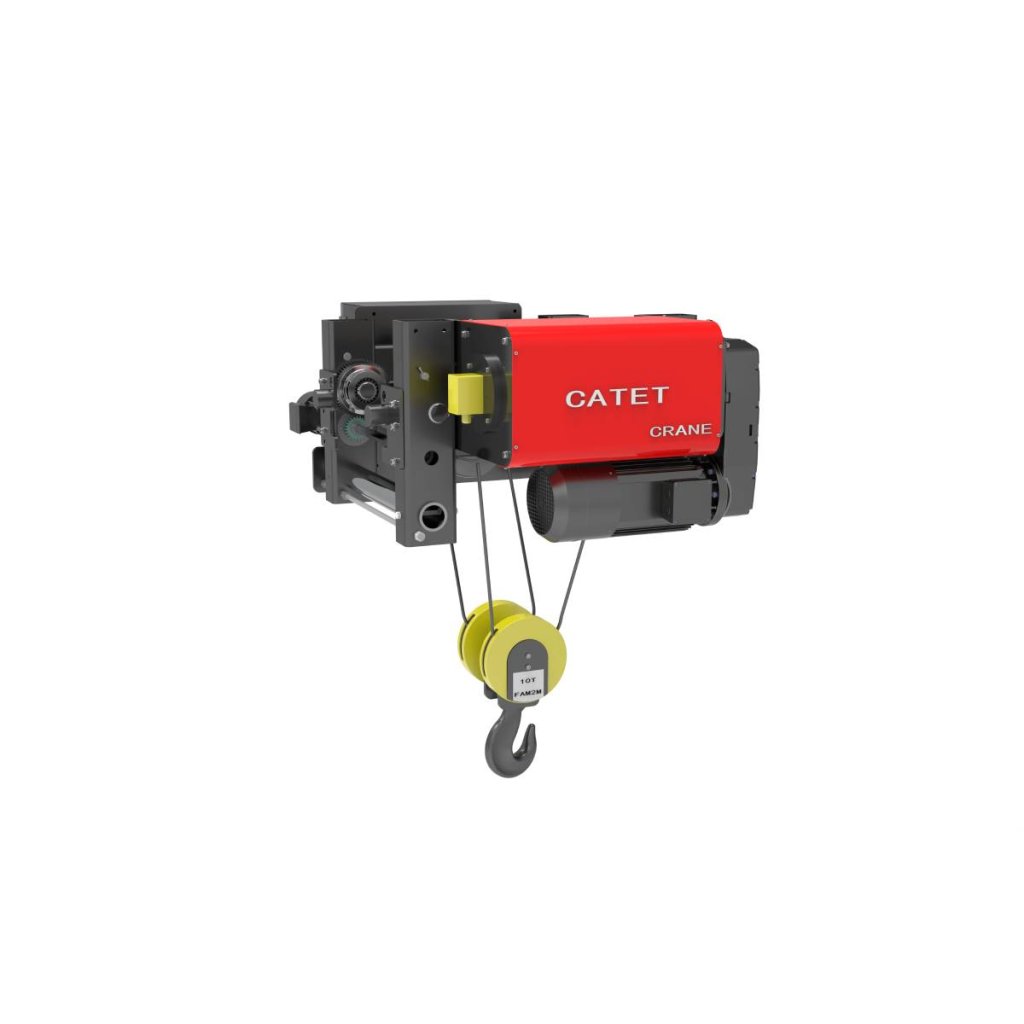
Electric hoists represent the lifting mechanism in single girder overhead crane systems. Wire rope hoists dominate capacities from 3 to 20 tons. They feature 6×19 or 6×37 wire rope configurations. Rope diameters range from 3/8 inch (1-ton) to 7/8 inch (20-ton). Safety factors typically exceed 5:1 per ASME B30.16 standards.
Lifting speeds vary by application and capacity. Light-duty systems operate at 16-32 feet per minute. Medium-duty applications use 8-16 FPM. Heavy-duty cycles require 3-8 FPM for controlled movements. Modern hoists incorporate variable frequency drives (VFDs). These provide stepless speed control from 10% to 100% of maximum. Additionally, micro-speed creep mode enables precision positioning at 5-10% speed.
Motor power requirements scale with capacity and speed. A typical 5-ton hoist uses 7.5 HP (5.5 kW) motors. 10-ton units require 15 HP (11 kW). 20-ton systems need 25-30 HP (18.5-22 kW). Three-phase power at 460V/60Hz is standard in North America. European designs use 400V/50Hz. Duty ratings follow FEM classifications from 2m (light) to 4m (heavy-medium).
End Truck Assembly Components
End trucks contain critical drive components weighing 300 to 1,200 pounds per unit. Specifically, each assembly includes forged steel wheels (8 to 16-inch diameter), sealed ball bearings rated for 50,000-hour L10 life, drive mechanisms with gear reducers (ratios from 20:1 to 80:1), and buffer systems with polyurethane or rubber shock absorbers.
Wheel materials use heat-treated alloy steel with hardness of 300-400 Brinell. Tread profiles follow ASCE rail standards. Contact stresses must not exceed 60,000 PSI to prevent premature wear. Proper lubrication extends wheel life to 8-12 years in normal service.
Drive configurations include independent or grouped systems. Independent drives provide 0.25 to 2 HP motors per end truck. This improves maneuverability with skew compensation. Travel speeds range from 40 to 160 feet per minute. Alternatively, grouped drives use single 0.5 to 3 HP motors with shaft coupling. This offers economical solutions achieving speeds of 65-100 FPM.
Applications Across Industries
Manufacturing and Production Facilities
Manufacturing facilities represent 45% of the single girder overhead crane market according to 2024 industry data. Specifically, assembly lines utilize these cranes for component positioning from 200 to 5,000 pounds. Parts flow smoothly between 8 to 20 workstations. Moreover, CNC machining operations depend on cranes for loading raw castings weighing 500 to 8,000 pounds. Subsequently, finished products weighing 300 to 6,000 pounds are efficiently removed.
A recent project at a precision machining facility in Michigan demonstrates typical benefits. The company installed a 10-ton single girder overhead crane with 45-foot span to serve their expanded production area. Previously, they relied on two forklifts operating 16 hours daily. The forklifts consumed approximately 8 gallons of propane per day at $3.50 per gallon. Annual fuel costs reached $9,100. Additionally, forklift maintenance averaged $4,200 per year per vehicle.
The crane installation cost $32,000 for equipment plus $11,500 for runway beams and installation. Total investment reached $43,500. However, the results were dramatic. Material handling time decreased from 8.5 minutes to 2.3 minutes per cycle—a 73% improvement. Moreover, forklift traffic in production areas was eliminated completely. This reduced product damage incidents from 23 to 3 annually, saving approximately $18,000 in scrap costs. Worker compensation claims decreased 40% in the first year.
The crane’s electrical consumption averages 18 kW during operation. At $0.12 per kWh and 6 hours daily operation, energy costs reach only $1,296 annually. Maintenance costs average $1,800 per year including annual inspection ($800), quarterly lubrication ($150 per visit), and minor component replacement. Consequently, the facility calculated payback within 2.1 years based solely on forklift elimination. Including productivity gains and reduced product damage, actual payback occurred in 14 months.
Warehouse and Logistics Operations
Warehouse and logistics operations represent 28% of single girder crane installations. First, loading and unloading operations become 60-75% more efficient than forklift-only operations. Palletized goods weighing 1,000 to 4,000 pounds move quickly between storage and shipping areas. Therefore, throughput increases from 12-15 loads per hour to 25-30 loads per hour.
An automotive parts distribution center in Ohio provides excellent demonstration of warehouse benefits. They implemented a 15-ton single girder overhead crane with 72-foot span. The span covered three loading docks simultaneously, serving an 18,000 square foot distribution area. Radio remote control allowed operators to work safely at ground level while maintaining complete visibility.
Installation completed in 22 working days without operational disruption. The project timeline included 8 days for runway beam installation, 3 days for crane assembly and lifting, 7 days for electrical work and commissioning, and 4 days for operator training and final testing. The crane cost $48,000 including hoist and control system. Runway beams, structural supports, and installation added $19,000. Electrical work contributed $7,500. Total investment of $74,500 seemed substantial initially.
Nevertheless, financial analysis revealed compelling returns. Prior to crane installation, the facility employed 6 forklift operators at $18.50 per hour working two shifts. Annual labor costs reached $461,000. Post-installation, 3 crane operators at $20.50 per hour handle the same volume. Annual labor costs decreased to $256,000—a savings of $205,000 annually. More importantly, loading times decreased from 42 minutes to 11 minutes per truck. This enabled processing 62 trucks daily versus 38 previously—a 63% improvement.
Forklift damage to inventory averaged $32,000 annually before crane installation. This dropped to $4,800 after implementation. Worker injury incidents decreased from 9 to 2 per year, reducing workers compensation premiums by $28,000 annually. The facility achieved full payback in 4.3 months based on labor savings alone.
Maintenance and Repair Facilities
Maintenance facilities across automotive, aerospace, and marine industries utilize single girder overhead crane systems extensively. For instance, engine removal and installation requires lifting 800 to 3,500 pounds with precision positioning within ±0.25 inches. Components must move safely through clearances of 2 to 6 inches without damage.
A commercial truck maintenance facility in Texas recently installed a 5-ton single girder crane with 35-foot span. The facility services diesel engines weighing 1,800 to 2,200 pounds. Previously, mobile engine hoists required 45-55 minutes per engine removal. The process needed two technicians working simultaneously. Additionally, floor jack positioning created workflow bottlenecks.
The new crane system, featuring a 10 FPM variable speed hoist and radio remote control, reduced engine removal time to 12-15 minutes with single-operator capability. This improvement allowed the facility to increase service capacity from 6 to 11 engines per day. At $1,200 average service revenue per engine, daily revenue potential increased from $7,200 to $13,200—an $6,000 gain.
The crane investment totaled $28,500 including $18,000 for equipment, $7,000 for installation, and $3,500 for runway structure. Based on the increased service capacity and resulting revenue improvement, payback occurred in just 4.8 days of operation. Within the first year, the investment generated an additional $1.5 million in service revenue while reducing labor costs by $78,000 through improved efficiency.
Technical Specifications and Performance Parameters
Load Capacity Classifications
Load capacity represents the most critical specification for any single girder overhead crane. Industry standards define capacity as the maximum load the hoist can safely lift, excluding the hoist’s self-weight. Manufacturers offer standard ratings following these intervals: 0.5, 1, 2, 3, 5, 8, 10, 15, and 20 tons. Additionally, custom capacities address unique requirements up to 32 tons for specialized single girder designs.
Safe working load (SWL) calculations incorporate safety factors mandated by ASME B30.2 and B30.16 standards. Specifically, wire rope systems require minimum 5:1 safety factors. Chain hoists need 7:1 factors. Therefore, a crane rated for 10 tons utilizes components that actually break at 50+ tons for wire rope systems or 70+ tons for chain configurations.
Capacity ratings must account for dynamic loading conditions. Impact factors range from 0.25 (light service) to 0.50 (severe service) times static load. For example, a 10-ton crane lifting at moderate speed creates peak loads of 12.5 tons (10 tons × 1.25 impact factor). Structural design must accommodate these dynamic forces plus hoist dead weight and bridge self-weight.
Span Length Considerations
Span length determines the distance between runway centerlines, directly impacting structural requirements and cost. Standard spans follow modular increments: 10.5, 13.5, 16.5, 19.5, 22.5, 25.5, 28.5, and 31.5 meters (34.4 to 103.3 feet). However, custom spans address specific facility dimensions. Market data shows 60% of installations use 30 to 60-foot spans. Spans under 30 feet represent 25% of projects. Long spans exceeding 60 feet comprise 15% of installations.
Span limitations vary by construction method and capacity. Wide flange girders economically handle spans to 60 feet for capacities under 10 tons. Beyond 60 feet, or for heavier capacities, box girder construction becomes necessary. The transition point balances material costs against fabrication complexity.
Deflection limits follow CMAA Specification #70 and #74 guidelines. Vertical deflection should not exceed L/800 for Class A through C service, or L/1000 for Class D through F. Lateral deflection limits range from L/400 to L/600. For example, a 50-foot span (600 inches) should deflect less than 0.75 inches vertically under full load. Excessive deflection causes wheel lift, uneven wear, and premature failure.
Travel Speed Parameters
Travel speeds significantly impact operational efficiency and productivity. Bridge travel speeds typically range from 40 FPM (light duty) to 160 FPM (heavy duty). Industry surveys show average speeds of 65-100 FPM serve most applications effectively. Hoist cross travel speeds range from 30 to 120 FPM depending on capacity and duty cycle.
Lifting speeds vary by application requirements and load weight. Light loads under 2 tons commonly lift at 16-32 FPM. Medium loads from 2-10 tons use 8-16 FPM. Heavy loads exceeding 10 tons require 4-8 FPM for controlled movements. Variable frequency drives enable multiple speed settings within these ranges.
Specifically, two-speed systems provide normal speed for routine operations plus micro-speed (typically 10-20% of normal) for precision work. Stepless VFD systems offer infinitely variable control from 5% to 100% of rated speed. This proves essential for assembly operations requiring ±0.125-inch positioning accuracy.
Acceleration and deceleration rates typically range from 1.5 to 4.0 feet per second squared. Slower rates reduce mechanical stress and load swing. CMAA guidelines recommend limiting acceleration to prevent load swing exceeding 3 degrees from vertical. Electronic controls can automatically adjust rates based on load weight using load sensing technology.
Installation Process and Requirements
Pre-Installation Structural Assessment
Pre-installation structural assessment forms the critical foundation of successful single girder overhead crane projects. First, structural engineers evaluate building load-bearing capacity using calculations per AISC (American Institute of Steel Construction) standards. Columns must support vertical loads including crane dead load (typically 150-300 pounds per foot of span), hoist weight (1,200-4,500 pounds), rated capacity, and dynamic impact forces.
Horizontal thrust forces also require analysis. Bridge acceleration creates lateral loads of 10-20% of lifted load. This transfers through end trucks to runway beams and supporting columns. Column design must resist these forces without excessive deflection. Existing buildings may need reinforcement through column jacketing, foundation strengthening, or brace installation.
Statistical data from installation contractors indicates approximately 35% of retrofit installations require structural modifications. These modifications cost $8,000 to $45,000 depending on scope. Typical improvements include installing supplemental steel bracing ($12,000-$18,000), concrete column jacketing ($8,000-$15,000 per column), foundation enhancement ($15,000-$35,000), and roof structure reinforcement ($20,000-$45,000).
Early assessment through site visits and structural calculations prevents costly surprises. Engineering analysis typically costs $2,500 to $6,500 but saves much larger modification expenses later. Building age proves a key factor—facilities constructed before 1990 show 50% higher modification rates than modern structures.
Runway Beam Installation Standards
Runway beam installation establishes the track system enabling crane travel. Alignment tolerances are critical for smooth operation and extended component life. CMAA Specification #70 establishes precise requirements. Specifically, horizontal straightness must remain within ±1/4 inch over any 20-foot span length. Additionally, elevation difference between parallel runways cannot exceed ±1/4 inch over the entire crane span.
Runway beam materials typically use ASTM A36 steel for structural shapes or ASCE 60 to ASCE 100 rail sections. Rail hardness ranges from 200 to 320 Brinell to resist wheel wear. Properly installed and maintained runway systems achieve 15-25 year service life. Conversely, poor alignment accelerates wear, reducing life to 5-8 years while increasing maintenance costs 200-300%.
Installation procedure begins with surveying and establishing reference lines. Transit levels or laser systems provide ±1/16 inch accuracy over 100-foot distances. Runway beams mount to building columns via bolted brackets or welded connections. Connection design must transfer vertical loads (400-2,000 pounds per foot) plus horizontal forces (50-300 pounds per foot).
Beam splices, where required for long runways, use bolted connections with minimum 8-12 high-strength bolts per joint. Splice plates distribute forces across 24 to 36 inches. Expansion joints accommodate thermal growth—steel expands approximately 0.0000065 inches per inch per degree Fahrenheit. A 200-foot runway experiencing 100°F temperature swing expands 1.56 inches.
Bridge Assembly and Lifting Procedures
The single girder overhead crane assembly typically occurs on ground level for safety and efficiency. First, main girder sections join if shipped in segments. Splice connections use high-strength bolts (typically Grade 8 or ASTM A490) torqued to 400-700 foot-pounds. Then, end trucks attach to girder ends via welded or bolted connections. Subsequently, the hoist installs on the girder’s lower flange and undergoes functional testing.
Mobile crane selection depends on component weights and lift height. A typical 10-ton single girder crane with 40-foot span weighs approximately 6,500 to 8,000 pounds. Adding hoist weight (2,200-2,800 pounds) brings total lifting weight to 8,700-10,800 pounds. Rigging gear adds another 500-800 pounds. Therefore, a 20-ton mobile crane provides adequate capacity with appropriate safety margin.
For larger installations, a 15-ton/60-foot system weighs 11,000-14,000 pounds. A 20-ton/80-foot configuration reaches 18,000-24,000 pounds. These require 40-ton to 60-ton mobile cranes. Mobile crane rental costs average $200-$400 per hour with 4-hour minimums. Typical installations require 6-12 hours of crane time, costing $1,200 to $4,800.
Rigging must distribute loads safely across 4-6 lifting points. Nylon or wire rope slings rated for 3:1 safety factors attach to designated lifting lugs. Spreader beams maintain proper sling angles (typically 45-60 degrees from vertical). Lift procedures follow ASME B30.5 standards with qualified riggers directing operations.
Weather restrictions apply to outdoor lifting. Wind speeds exceeding 15-20 MPH generally halt operations due to swing hazards. Rain or snow reduces visibility and increases slip risks. Optimal installation occurs during mild conditions (50-75°F, wind under 10 MPH, clear visibility).
Electrical Installation and Commissioning
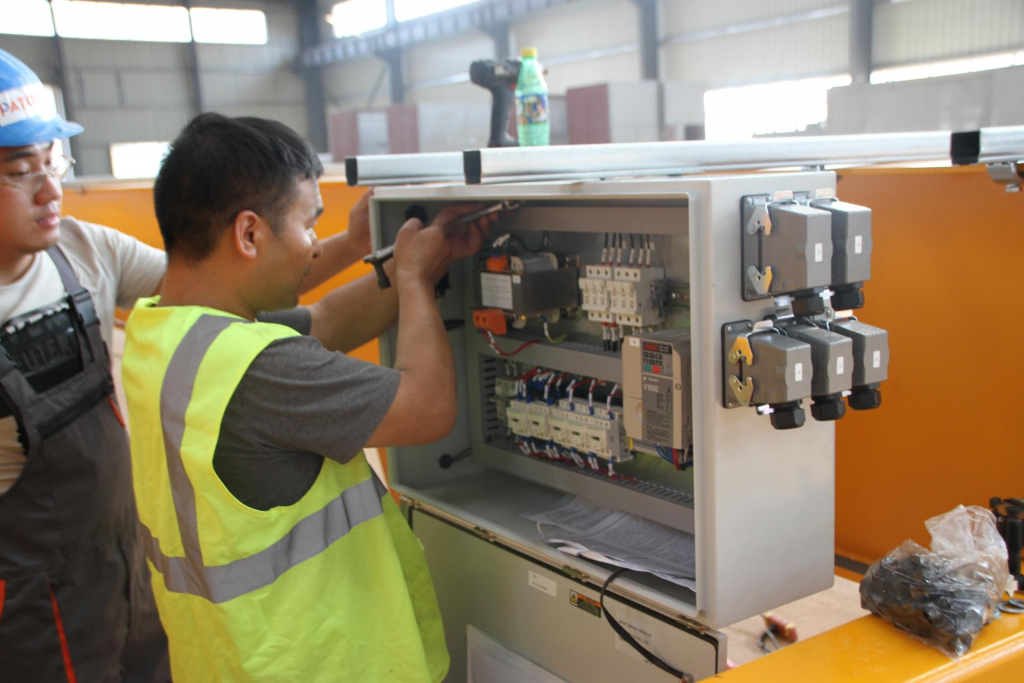
Electrical installation encompasses power distribution from building mains to crane, mobile power delivery along crane travel path, control systems, and safety circuits. Total electrical costs typically range from $4,500 to $15,000 depending on voltage, distance from power source, and control complexity.
Power requirements vary by crane capacity and features. A basic 5-ton system draws 15-25 kW during operation. A 10-ton crane requires 25-40 kW. A 20-ton unit needs 45-65 kW. Three-phase service at 480V/60Hz is standard in North America, requiring 40-100 ampere circuits with appropriate disconnect switches and overcurrent protection.
Conductor bar systems represent the most common mobile power delivery method. Copper bars (typically 1/2 inch × 2 inches) carry current along runway length. Collector shoes maintain contact through spring-loaded graphite or copper-graphite blocks. Installation costs average $45-$85 per linear foot including bars, hangers, and collectors.
Alternative cable festoon systems use flexible multi-conductor cables in roller trolley assemblies. These cost $35-$65 per linear foot but require more maintenance. Cable life typically ranges from 3-7 years versus 15-25 years for conductor bars.
Control systems installation requires 60-120 labor hours at $85-$125 per hour for qualified electricians. Pendant control systems (hanging pushbutton stations) cost $1,500-$3,500. Radio remote controls range from $3,800 to $8,500 depending on features. Advanced PLC-based systems with preset positions and automated sequences cost $12,000-$28,000.
Commissioning includes complete functional testing, load testing at 125% capacity per OSHA 1910.179, safety device verification, operator training (typically 8-16 hours), and documentation preparation. This process requires 2-4 days and costs $3,500-$7,500.
Cost Analysis and Investment Considerations
Equipment Pricing Structure
Equipment costs for single girder overhead crane systems show substantial variation based on specifications and features. A basic 3-ton capacity crane with 25-foot span costs $12,000-$18,000 for bridge and end trucks. Adding a standard wire rope hoist contributes $6,000-$9,000. Controls and electrical components add $2,500-$4,500. Total equipment cost ranges from $20,500 to $31,500.
Mid-range 10-ton systems with 45-foot spans cost significantly more. Bridge structures run $22,000-$32,000. Hoists add $12,000-$18,000. Enhanced controls contribute $4,500-$7,500. Total equipment investment reaches $38,500 to $57,500.
Heavy-duty 20-ton cranes with 65-foot spans represent upper-tier pricing. Bridges cost $45,000-$65,000. Heavy-duty hoists add $25,000-$38,000. Advanced control systems contribute $7,500-$12,000. Total equipment investment ranges from $77,500 to $115,000.
European-standard FEM designs command 30-50% premium pricing due to advanced engineering, higher-grade components, and superior performance. A 10-ton FEM crane costs $55,000-$85,000 versus $38,500-$57,500 for standard designs. However, FEM systems offer benefits including 40% better energy efficiency, 60% longer component life, 50% quieter operation, and superior precision (±0.125 inch versus ±0.5 inch positioning).
Installation Cost Factors
Installation expenses represent 15-25% of total project investment. Labor typically accounts for 55-65% of installation budgets at rates of $85-$125 per hour for skilled trades. A complete 10-ton system installation averages $11,000-$18,000 including all labor and equipment.
Detailed cost breakdown shows:
- Structural engineers (site assessment): 12-20 hours at $120-$150/hour = $1,440-$3,000
- Millwrights (crane assembly): 40-60 hours at $90-$115/hour = $3,600-$6,900
- Electricians (wiring and controls): 30-50 hours at $85-$110/hour = $2,550-$5,500
- Riggers (lifting operations): 8-16 hours at $75-$95/hour = $600-$1,520
- Crane operator (mobile crane): 8-12 hours at $95-$125/hour = $760-$1,500
Runway beam costs vary by span and capacity. A 40-foot span requires W12×26 beams costing $1,800-$2,400. Mounting brackets and hardware add $800-$1,200. Longer 80-foot spans need heavier W16×40 sections costing $4,200-$5,800. Box girder runways for heavy-duty applications cost $6,500-$11,000 per 60-foot span.
Mobile equipment rental includes scissor lifts ($150-$250 per day), boom lifts ($200-$350 per day), and welding equipment ($80-$150 per day). Typical projects require 5-10 days of equipment rental costing $1,500-$3,500 total.
Structural modifications significantly impact overall costs when required. Column reinforcement averages $6,500-$14,000 per column. Foundation work ranges from $18,000 to $52,000 depending on soil conditions and required strength. Therefore, comprehensive building assessment during planning prevents budget overruns.
Project timelines affect costs substantially. Rush installations requiring overtime or weekend work increase labor costs 50-100%. Conversely, flexible scheduling during facility shutdowns or slow periods can reduce costs 15-20% through standard-rate labor and optimized material delivery.
Operating Cost Benefits and ROI Analysis
Operating costs justify investment through improved efficiency and reduced expenses. Labor savings represent the primary financial benefit. Industry data shows one crane operator moving loads at $22-$28 per hour replaces 2-4 forklift operators at $18-$24 per hour. For facilities operating two shifts (16 hours daily), annual labor savings reach $58,000-$125,000.
Material handling speeds increase substantially. Cranes move loads 50-75% faster than forklifts in applications requiring vertical lifts. Productivity improvements of 30-60% are typical. For manufacturing facilities producing $2-$8 million annually, productivity gains worth $600,000-$4,800,000 over 10-year crane life provide substantial ROI.
Energy consumption remains modest compared to forklifts. A 10-ton single girder overhead crane draws 18-32 kW during operation (approximately 6 hours daily average). Annual energy consumption reaches 39,000-69,000 kWh. At $0.11 per kWh, annual electricity costs range from $4,290 to $7,590.
Conversely, two forklifts operating 16 hours daily consume 16-22 gallons of propane at $3.25-$3.85 per gallon. Annual fuel costs reach $19,000-$27,000. Additionally, forklift maintenance averages $4,800-$6,500 per vehicle annually. Combined operating costs for two forklifts total $28,600-$40,000 versus $6,000-$9,400 for crane operation (including maintenance).
Maintenance costs for single girder cranes average 2-3% of equipment value annually. A $45,000 crane requires $900-$1,350 annual maintenance. This includes:
- Annual OSHA inspection: $650-$950
- Quarterly lubrication: $120-$180 per service
- Wire rope replacement: $1,200-$1,800 every 3-5 years
- Brake adjustment: $200-$350 annually
- Miscellaneous repairs: $400-$800 annually
Payback period calculations show attractive returns. Facilities eliminating two forklifts save $22,000-$32,000 annually in operating costs. Adding productivity gains of $15,000-$45,000 brings total annual benefit to $37,000-$77,000. Against installation costs of $45,000-$75,000, payback occurs in 14-24 months. Consequently, 10-year ROI reaches 450-850%.
Need Expert Guidance on Single Girder Overhead Crane Selection?
Contact us today for free technical consultation backed by real engineering expertise. Our team provides customized recommendations considering your specific lifting requirements, facility constraints, and budget parameters. Moreover, we offer competitive quotations within 24 hours based on actual project specifications.
Contact Information:
- Email: [email protected]
- Tel/WhatsApp: +8615993097180
- Response Time: Technical quotes within 24 business hours
Safety Disclaimer: This article provides general information about single girder overhead cranes for educational purposes. Actual installations must be performed by qualified professionals following all applicable codes, standards, and manufacturer specifications. Consult licensed structural engineers and certified installation contractors for your specific project requirements. OSHA 1910.179 and ASME B30.2 compliance is mandatory.
Technical Specifications Disclaimer: All technical data, tolerances, and specifications referenced represent general industry standards per CMAA, ASME, and AISC publications. Specific projects may require different parameters based on unique conditions, local building codes, or engineering requirements. Always follow manufacturer recommendations and obtain professional engineering approval before installation.