After spending over a decade consulting with manufacturing facilities across three continents, I’ve witnessed a fundamental shift in how industrial operations approach internal logistics. The conversation has evolved from “How do we move materials efficiently?” to “How do we move materials flexibly?” This distinction represents more than semantics—it reflects a broader transformation in manufacturing philosophy that trackless transfer trolleys are uniquely positioned to address.
Today, I want to share my perspective on trackless transfer trolleys, a technology that solves practical challenges I’ve observed repeatedly in real-world operations while offering unprecedented operational flexibility.
The Infrastructure Problem Nobody Talks About
Let me start with a story from 2019. I was consulting for an automotive parts manufacturer in Ohio facing a common dilemma: their production layout needed complete reconfiguration to accommodate a new product line. The problem? Their entire material handling system relied on rail-guided transfer carts with tracks embedded throughout the facility floor.
The project estimate came back at $340,000 for track removal, floor restoration, and new track installation. The timeline? Eight weeks of partial production shutdown. This scenario isn’t unique—rail-guided systems require substantial upfront infrastructure investment including precision floor preparation, steel rail procurement and installation, and electrical conductor systems. More importantly, they create what I call “logistical permanence”—a commitment that becomes increasingly problematic as market conditions demand operational agility.
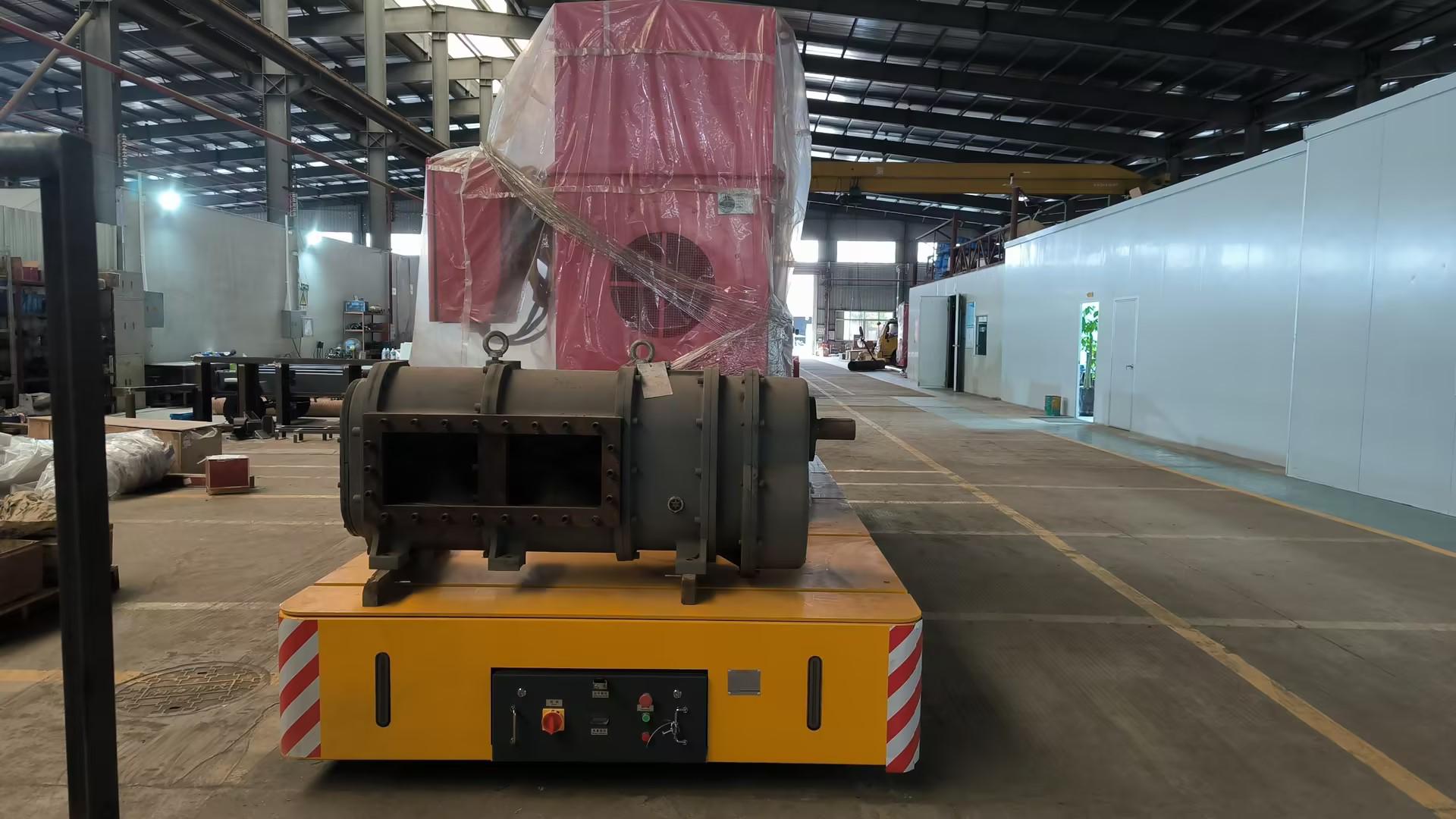
This is where trackless transfer trolleys fundamentally change the equation. These battery-powered material transporters operate on existing concrete surfaces without requiring fixed pathway infrastructure. Think of them as the industrial equivalent of switching from landline telephones to mobile devices—you’re not just upgrading technology; you’re gaining freedom of movement.
What Exactly Is a Trackless Transfer Trolley?
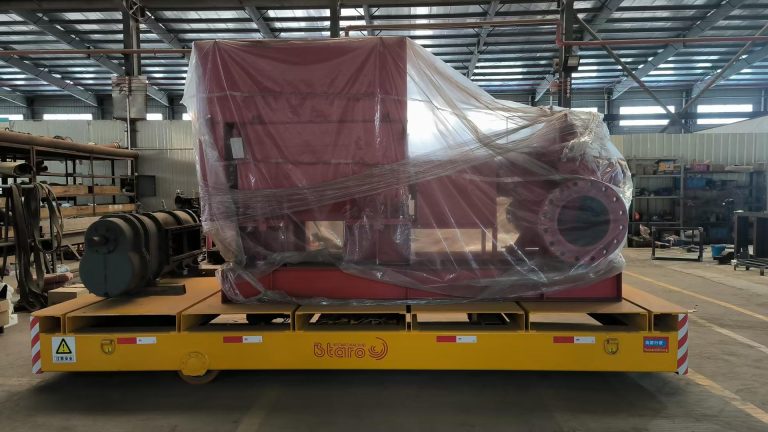
In technical terms, a trackless transfer trolley represents an electrically powered material handling platform designed for transporting heavy industrial loads across flat surfaces using onboard battery power and advanced steering mechanisms rather than rail guidance. But that definition doesn’t capture what makes these systems transformative.
From an operational perspective, trackless transfer trolleys combine three critical capabilities:
Autonomous Navigation: Modern trackless transfer trolleys employ magnetic guidance achieving ±10mm precision, laser navigation systems providing ±5mm accuracy, or inertial navigation protocols. Unlike their rail-guided predecessors that follow passive physical guides, trackless transfer trolley systems actively determine their position and adjust trajectory in real-time.
Load Capacity Scalability: Standard trackless transfer trolley configurations handle 10 to 200 tons, with specialized designs managing up to 500 tons. I’ve seen installations ranging from 5-ton units moving automotive stampings to 150-ton behemoths transporting steel coils in processing facilities.
Operational Flexibility: The ability to program multiple routes, execute 360-degree rotations, and operate omnidirectionally transforms material flow from a constraint into a strategic variable—something trackless transfer trolleys accomplish without infrastructure limitations.
The 2024 Material Handling Landscape: Why Trackless Transfer Trolleys Matter Now
The industrial automation market isn’t just growing—it’s accelerating. The global automated material handling equipment market reached USD 66.03 billion in 2024 and is predicted to reach approximately USD 170.64 billion by 2034, expanding at a CAGR of 9.96%. Within this expansion, Asia Pacific dominated with more than 39% revenue share in 2024, while North America is projected to grow at a notable CAGR of 11.5% through 2034.
What’s driving this surge toward solutions like trackless transfer trolleys? Three converging pressures I observe across industries:
Labor Market Realities: With 2.4 million manufacturing jobs expected to go unfilled by 2028, the global labor shortage ranks as 2024’s second most impactful industry challenge. This isn’t a temporary disruption—it’s a structural transformation requiring technology-based solutions like trackless transfer trolleys.
E-commerce Demand Pressure: The rapid expansion of e-commerce has significantly boosted demand for material handling equipment, as online retailers require efficient solutions to manage inventory and fulfill orders quickly. Distribution centers face throughput requirements that manual processes simply cannot meet, making trackless transfer trolleys an increasingly attractive solution.
Capital Investment Shift: Most manufacturers (55%) are increasing their investments in supply chain technology, including robotics and automation, with 88% planning to invest more than $1 million and 42% planning to invest more than $10 million. This represents a fundamental reassessment of where capital generates competitive advantage, with trackless transfer trolleys representing a strategic investment.
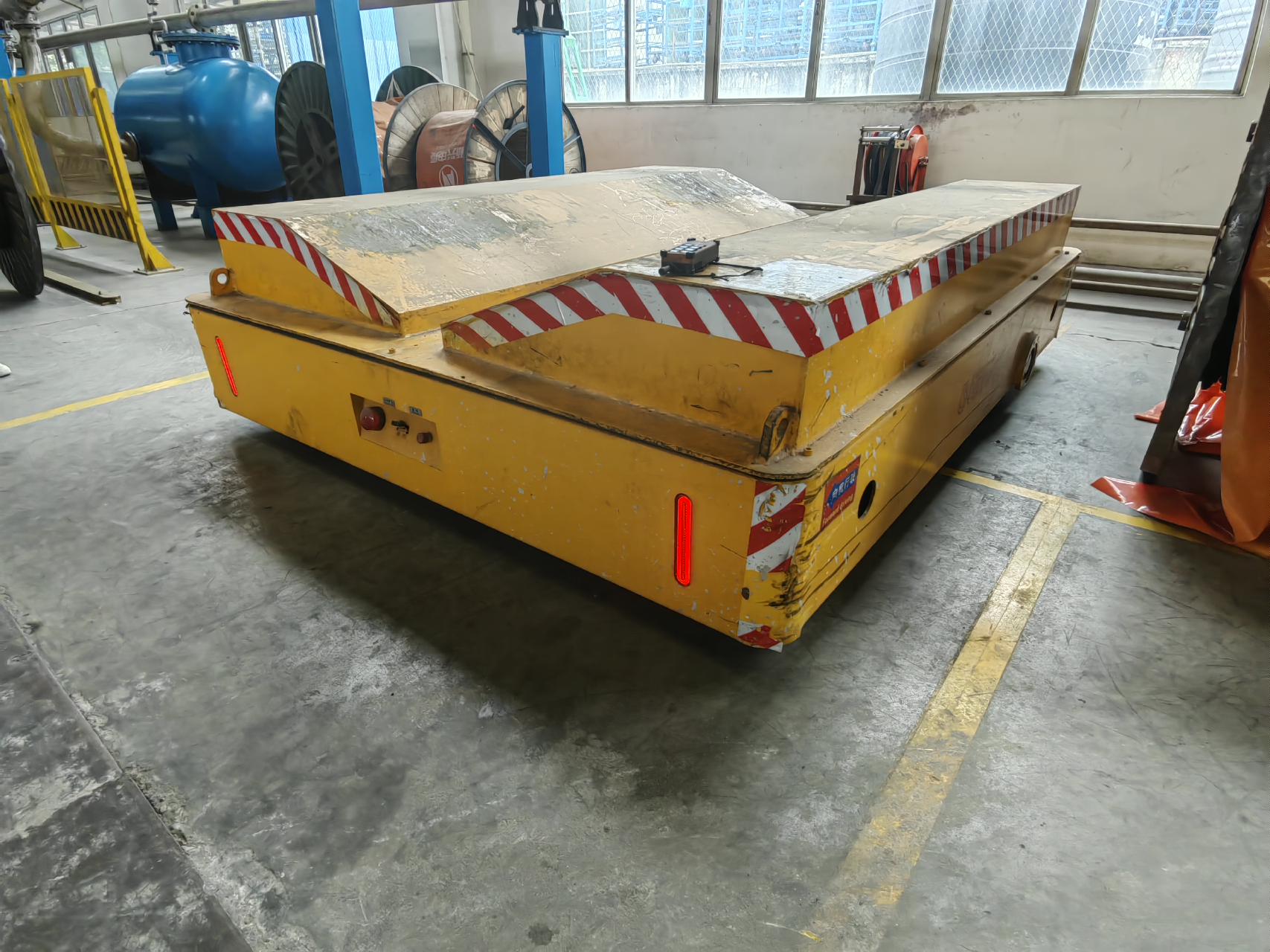
How Trackless Transfer Trolley Technology Actually Works
Understanding trackless transfer trolley systems requires examining their architectural components—not from a product specification perspective, but from a functional capability standpoint.
Power and Energy Management in Trackless Transfer Trolleys
Contemporary trackless transfer trolleys utilize lithium-ion battery configurations typically ranging from 24V to 72V. Here’s what matters operationally: lithium-ion batteries and hydrogen fuel cells are incredibly long-lasting and may be able to outlive the units they power. This represents a significant total cost of ownership advantage over traditional lead-acid battery systems requiring frequent replacement.
Battery management systems in trackless transfer trolleys integrate intelligent charging protocols enabling rapid recharging during production breaks. In practice, I’ve observed installations where trackless transfer trolleys automatically navigate to charging stations during scheduled downtime, requiring no operator intervention.
Steering and Maneuverability Systems
The most significant operational difference between trackless transfer trolleys and their rail-guided counterparts manifests in directional control. While rail-guided systems achieve positioning through passive track following, trackless transfer trolley variants employ active steering requiring sophisticated control algorithms.
Advanced trackless transfer trolley implementations utilize Mecanum wheel technology—a specialized wheel design incorporating rollers positioned at 45-degree angles around the wheel’s circumference. This configuration enables movements impossible with conventional wheels: lateral translation without rotation, diagonal movement, and in-place rotation. For operations requiring precise positioning in constrained spaces, this trackless transfer trolley capability proves transformative.
Navigation Technologies in Trackless Transfer Trolleys
Navigation methodology selection significantly impacts trackless transfer trolley system performance and implementation complexity. From my experience specifying trackless transfer trolley systems across diverse environments, three approaches dominate:
Magnetic Guidance: Magnetic tape or markers embedded in floor surfaces create navigation paths for trackless transfer trolleys. Detection sensors mounted on the trolley track these magnetic signatures, achieving ±10mm positional accuracy. This approach offers reliable trackless transfer trolley performance in industrial environments where visual systems might struggle with dust, lighting variations, or visual obstructions.
Laser Navigation: Laser positioning systems used in trackless transfer trolleys employ reflectors mounted at known locations throughout the facility. The trolley’s rotating laser scans its environment, calculates distances to multiple reflectors simultaneously, and triangulates its precise position. This methodology delivers ±5mm accuracy and enables dynamic route modification without physical infrastructure changes.
Inertial Navigation: Combining gyroscopes, accelerometers, and wheel encoders, inertial systems track trackless transfer trolley movement from a known starting position. While requiring periodic position correction through reference points, this approach operates independently of external infrastructure.
The optimal choice for your trackless transfer trolley depends on specific operational requirements. Facilities with stable layouts and defined pathways often benefit from magnetic guidance’s simplicity and cost-effectiveness. Operations requiring frequent route changes or operating across large, complex spaces typically justify laser navigation’s higher initial investment for their trackless transfer trolley fleet.
Real-World Trackless Transfer Trolley Performance: Data from Actual Installations
Theory matters less than operational reality. Let me share specific performance data from trackless transfer trolley installations I’ve either directly specified or thoroughly analyzed:
Automotive Manufacturing Case: Attendees at MODEX 2024 looking at autonomous mobile robots (AMRs) as a solution reported seeking to increase efficiency and combat the global labor shortage. In automotive applications specifically, facilities deploying trackless transfer trolley systems for die transportation between press shops and storage areas report 25-40% reductions in material handling cycle times compared to overhead crane operations.
Productivity Impact: According to the Automation Trends Report 2022, businesses utilizing AMRs have seen a 31% increase in both productivity and efficiency. While this data encompasses broader AMR categories, trackless transfer trolleys specifically contribute to this performance improvement through eliminated waiting time for shared handling equipment and reduced material queuing.
Safety Performance: Industrial environments employing trackless transfer trolleys with integrated collision avoidance systems report accident rate reductions of 40-60% compared to manual forklift operations for equivalent material handling tasks. This improvement stems from predictable automated movement patterns, comprehensive sensor coverage, and elimination of operator attention lapses.
Trackless Transfer Trolleys vs. Rail-Guided Systems: The Honest Comparison
Having specified both technologies across numerous projects, I can offer perspective beyond marketing claims on how trackless transfer trolleys compare to traditional systems. Each approach presents distinct advantages and limitations that matter differently depending on operational context.
When Rail-Guided Systems Still Make Sense
Despite trackless transfer trolley technology’s appeal, rail-guided systems maintain advantages in specific scenarios:
Ultimate Load Capacity: Rail carts are designed to better distribute weight and can carry heavier loads, easily transporting large machinery and equipment in heavy manufacturing enterprises, mines, and steel mills. For extremely heavy loads exceeding 300 tons with concentrated weight distribution, rail systems’ structural advantages remain relevant compared to trackless transfer trolleys.
Precision Requirements: Applications demanding positional accuracy beyond ±5mm—such as automated assembly operations with minimal clearance tolerances—may benefit from rail guidance’s inherent positioning consistency over trackless transfer trolley systems.
Long-Distance, High-Frequency Transport: Dedicated material corridors with constant bidirectional traffic between fixed points sometimes justify rail infrastructure investment over trackless transfer trolleys, particularly when distances exceed 500 meters and operational intensity supports infrastructure amortization.
Where Trackless Transfer Trolleys Deliver Superior Value
Trackless transfer trolleys have a high degree of flexibility, can travel freely on any flat ground, and can easily adapt to different working environments without track restrictions. This fundamental advantage manifests across multiple operational dimensions:
Implementation Speed: Trackless transfer trolleys don’t need to lay track; suppliers generally provide finished vehicles that can be used immediately at the work site, saving installation time and track costs. Typical deployment timelines for trackless transfer trolley systems: 4-8 weeks from order to operation, compared to 12-20 weeks for equivalent rail-guided installations.
Facility Adaptability: Manufacturing environments undergo continuous evolution. Product mix changes, process flow optimization, and capacity expansion require material handling flexibility. Trackless transfer trolley systems accommodate these changes through route reprogramming rather than physical infrastructure modification.
Multi-Path Operations: Because rail cars need to work on already-laid track, they cannot arbitrarily change transportation routes; once factory layout is adjusted or temporary route changes are needed, it faces relatively big problems requiring new track installation. Trackless transfer trolleys navigate between multiple pickup and delivery points without geometric constraints imposed by track intersections or switching mechanisms.
Cost Considerations: Total Economic Impact of Trackless Transfer Trolleys
Initial capital investment represents only one component of lifecycle economics for trackless transfer trolleys. My total cost of ownership analyses typically reveal:
Rail-guided systems present lower unit costs for the vehicles themselves but require substantial infrastructure investment. A 50-ton rail-guided transfer cart might cost $35,000-55,000, but track installation adds $300-600 per linear meter depending on power delivery systems and site conditions.
Trackless transfer trolley equivalents typically cost $60,000-90,000 per unit but operate on existing floors, eliminating infrastructure expense. For facilities requiring 100 meters of travel distance, trackless transfer trolley systems often achieve breakeven within 18-24 months through infrastructure savings alone.
Operational cost differences favor trackless transfer trolleys long-term: these systems require maintenance of batteries, motors, and tires, while rail carts need regular track inspection and maintenance; if track is worn or deformed, timely maintenance is required. Track maintenance represents an often-underestimated ongoing expense requiring specialized expertise and equipment.
Industry-Specific Trackless Transfer Trolley Applications
Automotive Manufacturing: The Primary Trackless Transfer Trolley Market
Automotive applications account for approximately 45% of trackless transfer trolley deployments. This dominance reflects both the industry’s scale and its specific operational characteristics.
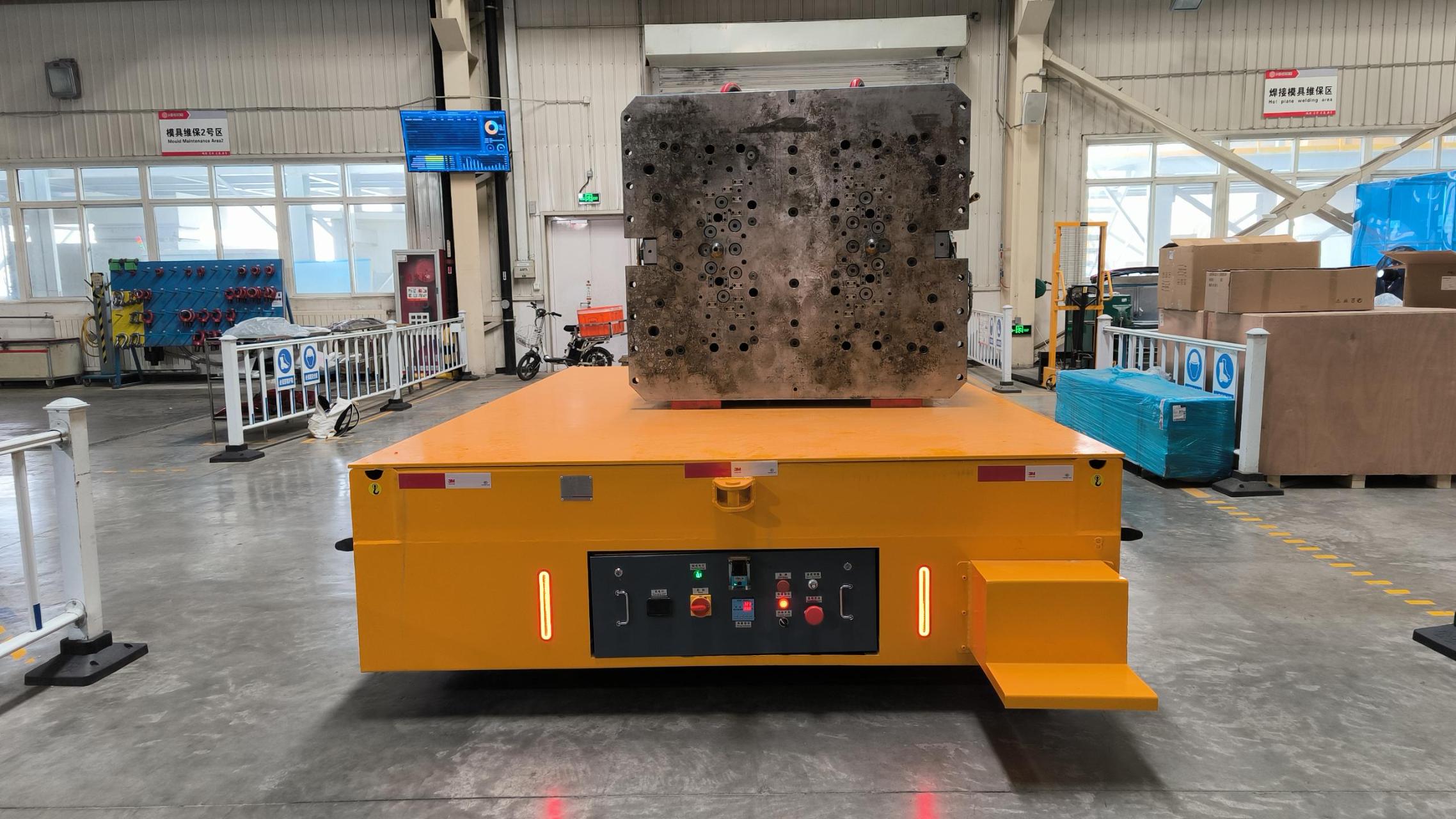
Die transportation represents the most common trackless transfer trolley application. Stamping dies weighing 15-50 tons require frequent movement between presses, storage, and maintenance areas. Trackless transfer trolley systems excel here because die change schedules vary unpredictably based on production sequences, making fixed routing inefficient.
Body assembly operations increasingly deploy trackless transfer trolleys for component sequencing. As automotive production shifts toward mass customization with multiple variants on single production lines, flexible material presentation becomes critical. Trackless transfer trolley systems deliver components to line-side positions based on real-time production schedules rather than fixed sequences.
Steel Production and Metal Processing with Trackless Transfer Trolleys
Steel mills represent approximately 30% of the trackless transfer trolley market. These environments present unique challenges: extreme temperatures, heavy loads, and facilities spanning large geographical areas with evolving layouts.
Coil handling constitutes the dominant trackless transfer trolley application in this sector. Steel coils ranging from 5 to 50 tons require transportation from production lines to storage, processing, or shipping. The ability of trackless transfer trolleys to navigate between multiple storage bays without track infrastructure proves particularly valuable in operations managing diverse product specifications.
Distribution Centers Adopting Trackless Transfer Trolleys
The expanding 3PL sector globally, growing at over 6% CAGR, increasingly adopts material handling equipment like trackless transfer trolleys due to rising supply chain complexity. E-commerce fulfillment centers face unique challenges: variable throughput demands, seasonal volume fluctuations, and facility reconfigurations to accommodate changing client requirements.
Trackless transfer trolleys address these challenges by providing scalable material handling capacity without fixed infrastructure. During peak seasons, facilities can temporarily increase their trackless transfer trolley fleet size, then reduce it as volumes normalize—an impossible proposition with rail-guided systems.
The Technology Evolution of Trackless Transfer Trolleys
While industry attention focuses on artificial intelligence and machine learning integration, I observe three less publicized but equally significant technological trends shaping trackless transfer trolley evolution:
Fleet Coordination Protocols for Trackless Transfer Trolleys
Early trackless transfer trolley implementations operated essentially as independent vehicles. Current developments enable multi-vehicle coordination—multiple trackless transfer trolleys sharing operational space, negotiating right-of-way, and collaborating on complex material handling sequences.
This capability transforms operational possibilities with trackless transfer trolleys. Rather than sizing individual trolleys for worst-case loads, facilities can deploy smaller trackless transfer trolley units that collaborate for heavy or oversized items. This approach improves average equipment utilization while maintaining capacity for exceptional requirements.
Predictive Maintenance Integration in Trackless Transfer Trolleys
Automation systems are becoming robust data generators, helping organizations learn, adapt, and optimize operations through tracking key metrics such as battery life, location, and cycle time. Modern trackless transfer trolleys generate continuous operational data: motor current draw, battery state of charge, wheel bearing temperatures, and control system diagnostics.
Machine learning algorithms analyze these data streams from trackless transfer trolleys to predict component failures before occurrence. I’ve observed installations where this capability reduces unplanned downtime by 30-40% while enabling maintenance scheduling optimization.
Energy Efficiency Advancement in Trackless Transfer Trolleys
Battery technology improvements receive substantial attention, but system-level efficiency gains in trackless transfer trolleys prove equally important. Regenerative braking captures deceleration energy for battery recharging. Optimized route planning reduces unnecessary travel distance. Intelligent power management reduces auxiliary system consumption during idle periods.
Collectively, these improvements deliver 20-30% energy consumption reductions in trackless transfer trolleys compared to earlier generations—meaningful both economically and environmentally.
Implementation Realities for Trackless Transfer Trolleys
Having guided numerous trackless transfer trolley implementations, I’ve identified critical success factors that technical specifications alone don’t capture:
Floor Condition Assessment for Trackless Transfer Trolleys
Floor quality directly impacts trackless transfer trolley performance. Unlike rail-guided systems riding on precisely leveled tracks, trackless transfer trolleys respond to every floor irregularity. Concrete floors must meet flatness specifications—typically FL25 or better for light loads, FL50 for heavy trackless transfer trolley applications.
Floor remediation represents a common hidden cost when implementing trackless transfer trolleys. Facilities with floors meeting specifications avoid this expense. Those with degraded floors face $15-40 per square meter remediation costs depending on severity. Thorough floor assessment before trackless transfer trolley equipment selection prevents expensive surprises.
Operational Training Requirements for Trackless Transfer Trolleys
Businesses are implementing more stringent training requirements to verify all operators are trained on proper equipment use, meeting OSHA reporting requirements and general staff safety standards. Effective trackless transfer trolley operator training extends beyond basic control operation. Understanding battery management, recognizing maintenance indicators, and properly securing diverse load types significantly impacts safety and equipment longevity.
I recommend 16-24 hours of initial training for trackless transfer trolley operation including hands-on practice under supervision, followed by competency assessment. Organizations underinvesting in trackless transfer trolley training typically experience 3-4x higher accident rates and 2-3x shorter equipment lifecycles.
Integration with Existing Systems
Trackless transfer trolleys don’t operate in isolation. Integration with warehouse management systems (WMS), manufacturing execution systems (MES), and enterprise resource planning (ERP) platforms transforms trackless transfer trolleys from simple transportation devices into intelligent components of broader operational ecosystems.
This integration enables automated dispatch of trackless transfer trolleys based on production schedules, real-time location tracking, and comprehensive utilization analytics. The difference between basic and sophisticated integration often determines whether trackless transfer trolley systems deliver 20% or 60% efficiency improvements.
Common Misconceptions About Trackless Transfer Trolleys
“Trackless Transfer Trolleys Can’t Handle Our Load Requirements”
This perception persists despite clear evidence contradicting it. Trackless transfer trolleys offer solutions designed for effective, safe, and precise transportation of loads ranging from 5 to 400 tons within industrial facilities. While rail-guided systems maintain advantages at extreme capacities, trackless transfer trolley technology addresses 95% of industrial load requirements.
The specification process for trackless transfer trolleys requires proper engineering. Load capacity must account not just for maximum weight but also for load distribution, center of gravity height, and dynamic forces during acceleration and cornering. Properly specified trackless transfer trolley systems reliably handle loads many assume require rail guidance.
“Battery Life Limits Trackless Transfer Trolley Utility”
Battery anxiety—concern about runtime limitations—represents a common objection to trackless transfer trolleys. In practice, proper battery sizing addresses most operational requirements. Lithium-ion batteries in trackless transfer trolleys typically deliver 4-6 hours of continuous operation under full load, with opportunity charging during breaks extending effective runtime indefinitely.
For operations requiring 24/7 trackless transfer trolley availability, battery swapping systems enable tool-free battery exchange in under 5 minutes, or facilities deploy multiple trackless transfer trolleys rotating through charging cycles. Battery limitations rarely constrain properly planned trackless transfer trolley implementations.
Environmental and Sustainability Considerations for Trackless Transfer Trolleys
Sustainability increasingly influences material handling equipment decisions. Trackless transfer trolleys contribute to environmental objectives through multiple mechanisms:
Zero Direct Emissions: Battery-electric operation in trackless transfer trolleys eliminates combustion emissions within facilities, improving air quality and reducing ventilation requirements. For facilities pursuing LEED certification or equivalent environmental standards, this trackless transfer trolley attribute proves significant.
Energy Efficiency: Replacing legacy systems with alternatives using electricity only when actively moving cargo represents an important energy-efficiency strategy; for example, replacing a 5-foot Chain Driven Live Roller conveyor could save up to 81% in energy usage with MDR systems. While this specific example addresses conveyors, the principle applies broadly to trackless transfer trolleys: electric systems operating on-demand consume substantially less energy than continuously running mechanical alternatives.
Extended Equipment Lifecycle: Properly maintained trackless transfer trolleys typically achieve 15-20 year service lives, with major components like battery packs replaceable at 5-7 year intervals. This longevity reduces embodied energy consumption compared to equipment requiring more frequent replacement.
Looking Forward: What’s Next for Trackless Transfer Trolley Technology
Based on current development trajectories and conversations with leading manufacturers, I anticipate several significant advances in trackless transfer trolley technology over the next 3-5 years:
Autonomous Operation Expansion for Trackless Transfer Trolleys
Current trackless transfer trolleys primarily operate under direct operator control or follow pre-programmed routes. Emerging trackless transfer trolley systems integrate SLAM (Simultaneous Localization and Mapping) algorithms enabling autonomous navigation in dynamic environments without pre-defined pathways.
This capability doesn’t eliminate operators—it shifts their role from constant trackless transfer trolley control to supervisory management, allowing one operator to oversee multiple trackless transfer trolleys simultaneously while focusing on exception handling and load management.
5G Connectivity Integration in Trackless Transfer Trolleys
Telemetry involves remote data collection with wireless technology, making it easier to stay on top of preventive maintenance and identify issues; tracking activity and usage trends can identify pain points and encourage fewer accidents. Next-generation 5G wireless infrastructure enables high-bandwidth, low-latency communication supporting advanced trackless transfer trolley capabilities: remote diagnostics, over-the-air software updates, and cloud-based fleet optimization algorithms.
Making the Trackless Transfer Trolley Decision: A Framework
For organizations evaluating trackless transfer trolley adoption, I recommend a structured assessment framework. Request a consultation with our engineering team to discuss your specific operational requirements and receive a customized recommendation.
Operational Requirements Definition: Document load characteristics (weight, dimensions, frequency), transport distances, pathway complexity, and environmental conditions for your trackless transfer trolley application. Be specific—general requirements lead to suboptimal trackless transfer trolley specifications.
Infrastructure Assessment: Evaluate floor conditions, available charging locations, clearance dimensions, and integration requirements with existing systems before implementing trackless transfer trolleys. Infrastructure limitations often constrain technology choices more than equipment capabilities.
Total Cost Analysis: Calculate comprehensive lifecycle costs for trackless transfer trolleys including equipment, infrastructure, installation, training, maintenance, and energy consumption over projected equipment lifespan. Compare against current material handling costs and alternative technologies.
Vendor Evaluation: Assess trackless transfer trolley manufacturers based on relevant experience, engineering capabilities, global support infrastructure, and demonstrated installation success in comparable applications. Request and verify customer references, particularly trackless transfer trolley installations with similar operational profiles.
Pilot Implementation: For large-scale deployments, consider piloting trackless transfer trolleys with limited equipment quantity to validate performance assumptions before full commitment. Pilots expose unforeseen integration challenges and operational considerations theoretical analysis overlooks.
The Bottom Line: Why Trackless Transfer Trolleys Matter Now
The material handling landscape faces unprecedented change. Labor constraints, demand variability, and competitive pressure demand operational flexibility that traditional fixed-infrastructure approaches cannot deliver—precisely what trackless transfer trolleys provide.
Trackless transfer trolleys represent more than incremental improvement—they fundamentally change what’s possible in internal logistics. The ability to reconfigure material flow through software rather than physical infrastructure modification transforms facilities from static to adaptive systems.
This adaptability matters because manufacturing and distribution operations now compete not just on cost efficiency but on responsiveness. Markets increasingly reward organizations that can rapidly introduce new products, accommodate variable demand, and optimize operations based on real-time data—all capabilities enhanced by trackless transfer trolley deployment.
From my perspective as someone who’s helped organizations navigate this transition, trackless transfer trolleys aren’t just better material handling equipment—they’re enablers of fundamentally different operational strategies. Organizations successfully deploying these systems don’t simply move materials more efficiently; they reimagine what flexible manufacturing actually means.
The technology has matured beyond early adoption risks. Performance data from thousands of trackless transfer trolley installations demonstrate reliability and economic viability. The remaining question isn’t whether trackless transfer trolleys deliver value, but rather how to best leverage their capabilities within specific operational contexts.
For manufacturing and logistics operations serious about operational flexibility, the conversation about trackless transfer trolleys isn’t about if, but when and how.