How to Choose the Right Jib Crane for Your Workspace 2026
Making the Critical Decision: Your Complete Jib Crane Selection Guide
Selecting the right jib crane for your workspace represents a significant investment decision that impacts productivity, safety, and operational efficiency for years to come. The wrong choice can result in underutilized equipment, workflow bottlenecks, or worse—safety hazards from inadequate lifting capacity or improper installation. Conversely, a properly selected jib crane transforms material handling operations, reducing manual labor, improving cycle times, and enhancing workplace safety.
The jib crane market offers diverse options spanning multiple configurations, capacity ratings, and installation methods. Industry data from the Crane Manufacturers Association of America indicates that businesses implementing appropriate jib crane solutions typically achieve 30-45% improvement in material handling efficiency while reducing workplace injuries by up to 40%. However, realizing these benefits requires careful evaluation of your specific operational requirements, workspace constraints, and long-term business needs.
Many facility managers and engineers face challenges navigating the complex landscape of jib crane specifications, capacity calculations, and compliance requirements. Furthermore, evolving workplace safety regulations and technological advancements continue reshaping jib crane design and capabilities. The 2026 jib crane market introduces enhanced safety features, improved ergonomics, and smart monitoring technologies that optimize performance and maintenance planning.
This comprehensive buyer’s guide examines every critical factor in jib crane selection, from understanding different jib crane configurations to calculating precise capacity requirements. Additionally, we’ll explore installation considerations, workspace analysis, budget planning, and ongoing maintenance requirements. By understanding these essential elements, you’ll be equipped to make confident jib crane purchasing decisions that deliver maximum value for your specific application.
Understanding Jib Crane Fundamentals and Configurations
What Is a Jib Crane and How Does It Work?
A jib crane consists of a horizontal boom (the jib) that supports a hoist and trolley system, mounted on a vertical mast or attached to a building structure. This configuration enables the hoist to move both radially along the boom and rotationally around the mast, providing coverage across a semicircular or full circular work area. The fundamental design principle allows operators to position loads precisely within the crane’s coverage area with minimal physical effort.
The jib crane’s primary components include the boom assembly, mast or mounting structure, rotation bearing, hoist and trolley system, and control mechanisms. Modern jib cranes incorporate sealed bearings, precision-machined rotation systems, and ergonomic controls that enhance operator efficiency while extending equipment lifespan. Capacity ratings typically range from 125 pounds for light-duty applications to 20 tons or more for heavy industrial installations.
Compared to overhead bridge cranes or gantry cranes, jib cranes offer superior flexibility for localized material handling operations. They occupy minimal floor space, provide quick installation, and deliver excellent cost-effectiveness for dedicated work stations. However, jib cranes serve specific coverage areas rather than facility-wide material movement, making them ideal for repetitive lifting tasks within defined workspaces.
Major Jib Crane Types and Configurations
The jib crane category encompasses several distinct configurations, each optimized for specific installation scenarios and operational requirements. Understanding these fundamental types proves essential for matching equipment capabilities with your workspace needs.
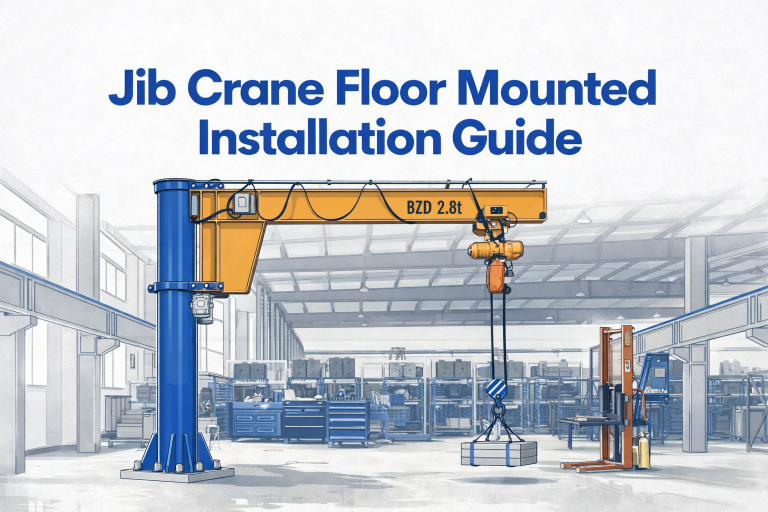
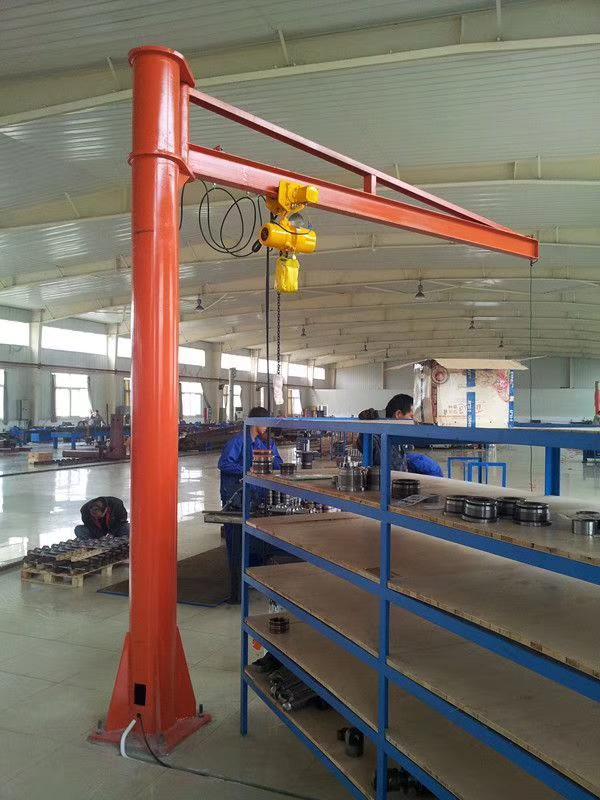
Floor-Mounted Jib Cranes represent the most versatile and commonly installed configuration. These units feature a vertical mast anchored directly to a reinforced concrete foundation, providing 360-degree rotation and maximum coverage area. Floor-mounted jib cranes suit applications requiring full circular coverage or where building structure cannot support the crane loads. Capacity ratings typically range from 250 pounds to 20 tons with boom lengths extending up to 40 feet.
Installation requires substantial foundation preparation including concrete pads typically 4-6 feet square and 3-4 feet deep, depending on crane capacity. The floor-mounted configuration consumes minimal overhead clearance, making it ideal for facilities with height restrictions. Moreover, these jib cranes can be relocated if facility layouts change, though foundation work must be repeated at new locations.
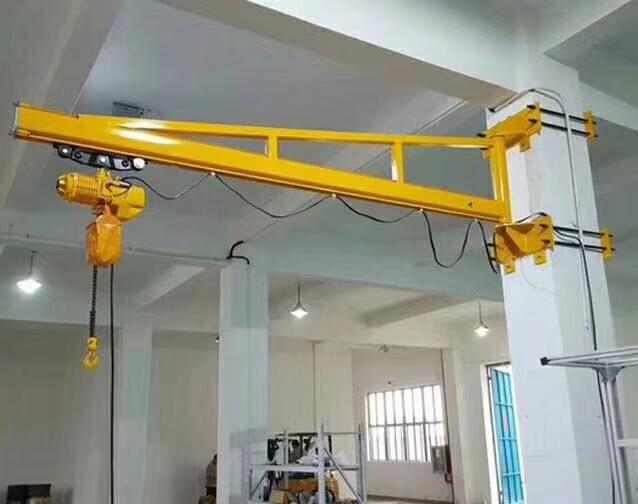
Wall-Mounted Jib Cranes attach directly to existing building columns or walls, eliminating foundation requirements and maximizing floor space utilization. These units typically provide 180-200 degrees of rotation, covering a semicircular work area adjacent to the mounting structure. Wall-mounted jib cranes prove particularly effective along production lines, loading docks, and machine shops where floor space is premium.
Structural requirements prove critical for wall-mounted installations. The building column or wall must possess sufficient strength to support crane loads plus dynamic forces during operation. Typically, steel I-beam columns or reinforced masonry walls provide adequate support, while standard stud walls require substantial reinforcement. Capacity ratings generally extend from 125 pounds to 5 tons with boom lengths up to 30 feet.
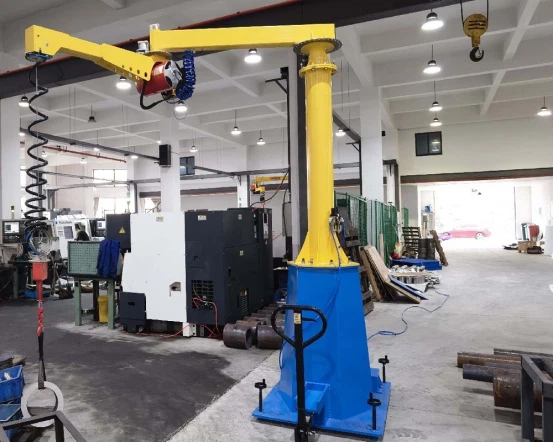
Articulating Jib Cranes feature dual booms connected by a pivot joint, providing exceptional maneuverability around obstacles and into confined spaces. The inner boom mounts to the mast while the outer boom pivots independently, enabling operators to position loads precisely even when direct line-of-sight paths are blocked. This configuration excels in tooling applications, machine tool servicing, and assembly operations requiring access to multiple work zones.
The articulating design trades some lifting capacity for enhanced flexibility. These jib cranes typically handle loads from 250 pounds to 2 tons with combined boom reach extending to 20-25 feet. The dual-boom configuration requires more complex structural analysis and typically costs 40-60% more than comparable capacity standard jib cranes.
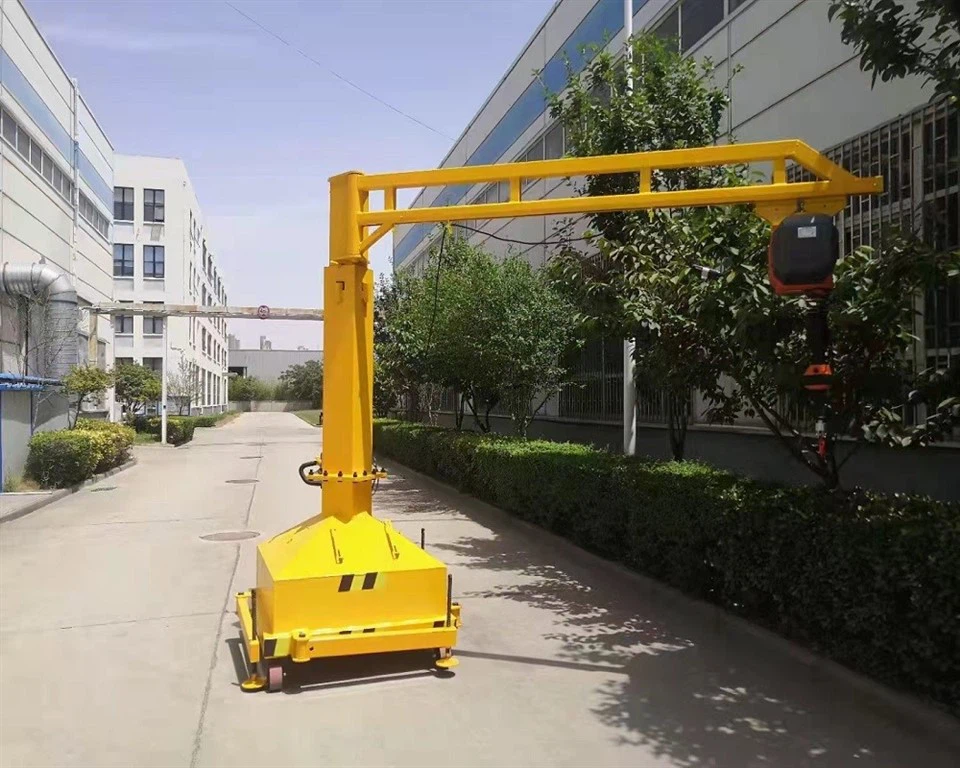
Portable Jib Cranes offer mobility through wheeled bases or forklift pockets, enabling movement between work areas as operational needs change. These units sacrifice some stability and capacity compared to permanently installed alternatives but provide unmatched flexibility for facilities with changing production layouts or temporary lifting requirements. Portable jib cranes typically handle loads from 250 pounds to 2 tons with boom lengths extending to 12-16 feet.
Stability considerations prove paramount with portable designs. Most units incorporate wide wheeled bases, outriggers, or counterweight systems ensuring safe operation. However, floor surface conditions significantly impact stability—smooth, level concrete provides optimal performance while uneven or soft surfaces compromise safety. Additionally, these jib cranes cannot match the precision or smooth operation of rigidly mounted alternatives.
Determining Your Jib Crane Capacity Requirements
Understanding Load Capacity and Safety Factors
Jib crane capacity selection requires careful analysis of actual load weights plus appropriate safety margins. The rated capacity represents the maximum load the crane can safely handle under ideal conditions, but real-world applications demand additional considerations ensuring safe, reliable operation.
Begin by identifying the heaviest load you’ll lift regularly. Weigh actual loads rather than estimating—components often weigh significantly more than intuitive guesses suggest. For instance, a steel fabrication shop discovered their “approximately 1,000-pound” steel plate assemblies actually weighed 1,450 pounds when properly measured. This 45% discrepancy could have resulted in dangerous overloading had they selected a 1-ton jib crane based on estimates.
Next, account for rigging equipment weight. Slings, hooks, spreader bars, and specialized lifting fixtures add substantial weight to the total suspended load. Heavy-duty rigging for large loads can easily add 200-300 pounds or more. Therefore, calculate total lifted weight as load weight plus rigging weight plus a safety margin.
Industry best practices recommend selecting jib crane capacity at least 25% above your maximum anticipated lifted load. For example, if your heaviest load plus rigging totals 1,600 pounds, specify a jib crane rated for 2,000 pounds (1 ton) minimum. This safety margin accommodates load weight variations, accounts for dynamic forces during lifting and movement, and provides buffer capacity for future operational changes.
However, avoid excessive over-specification. A jib crane rated for significantly more capacity than required costs substantially more initially and imposes higher structural requirements on mounting foundations or building structures. Furthermore, oversized equipment may operate less efficiently for typical loads, as hoist and trolley systems optimized for heavy loads can respond sluggishly when handling lighter materials.
Dynamic Load Considerations
Static load weight represents only part of capacity analysis. Dynamic forces during crane operation multiply effective loads, requiring additional capacity consideration. When the hoist initially lifts a load, inertial forces temporarily increase the effective weight—a phenomenon called “shock loading.” Similarly, sudden stops, swinging loads, and rapid acceleration generate dynamic forces exceeding static weight.
Most jib crane manufacturers design their equipment to handle reasonable dynamic loads within rated capacity. However, applications involving frequent shock loading, high-speed operations, or impact forces may require additional capacity margins or specialized heavy-duty components. Consult with jib crane manufacturers about your specific application characteristics to ensure proper equipment selection.
Additionally, consider whether you’ll lift loads near maximum capacity frequently or occasionally. Jib cranes operated consistently near rated capacity experience accelerated wear and shortened service life compared to units typically handling lighter loads. If your application regularly approaches maximum capacity, consider specifying the next higher capacity rating to extend equipment longevity and reduce maintenance requirements.
Boom Length and Coverage Area Analysis
Boom length directly determines the jib crane’s coverage area and influences structural requirements, cost, and performance characteristics. Longer booms provide expanded reach but require stronger support structures, cost more, and may exhibit reduced rigidity affecting precise load positioning.
Measure the actual distance from the proposed mast location to the farthest point where loads must be positioned. This dimension establishes minimum boom length requirements. However, consider coverage overlap—positioning the mast location to provide some reach beyond your immediate work area offers flexibility for future layout changes or expanded operations.
Moreover, account for hoist trolley dimensions. The trolley cannot travel completely to the boom ends due to mechanical constraints and safety clearances. Typically, effective reach extends to approximately 6-12 inches less than stated boom length on each end. For critical applications requiring precise coverage, verify actual working dimensions with manufacturers before finalizing specifications.
Rotation angle also impacts effective coverage area. Floor-mounted jib cranes typically provide 360-degree rotation, creating circular coverage areas. Wall-mounted units generally offer 180-200 degrees, covering semicircular zones. Calculate actual coverage area using the formula: Area = π × radius² × (rotation angle ÷ 360°). For example, a floor-mounted jib crane with 15-foot boom provides approximately 707 square feet coverage (π × 15² = 707 sq ft), while a 180-degree wall-mounted unit with identical boom covers approximately 354 square feet.
Workspace Analysis and Installation Considerations
Evaluating Floor Space and Overhead Clearance
Effective jib crane installation requires comprehensive workspace analysis addressing both floor space utilization and overhead clearance requirements. Floor-mounted jib cranes consume relatively little floor space—the mast occupies only the foundation footprint, typically 3-5 feet square. However, the boom’s rotation path must remain clear of obstructions throughout its full range of motion.
Create a scale drawing of your workspace including the proposed jib crane location and full rotation coverage area. Identify any obstructions including equipment, storage racks, workbenches, doorways, and structural columns. Ensure adequate clearance exists not only for the boom itself but also for suspended loads swinging during movement. Industry standards recommend maintaining minimum 12-inch clearance between the boom and any obstruction during rotation.
Overhead clearance proves equally critical. Calculate the total height requirement as: foundation height + mast height + boom under-clearance + hoist height + hook height + load height. This total must fit within your facility’s clear height with adequate margin for safety and comfort. Compressed overhead clearance creates hazardous conditions and limits operational flexibility.
For facilities with limited overhead clearance, consider low-headroom hoist options. These specialized hoists position the trolley and lifting mechanism closer to the boom, reducing total height requirements by 12-24 inches or more compared to standard hoists. However, low-headroom hoists typically cost 30-40% more than standard configurations.
Building Structure and Foundation Requirements
Jib crane installation imposes substantial loads on building structures or foundations, requiring careful engineering analysis to ensure safe, code-compliant installations. The forces involved include vertical loads (crane weight plus lifted loads), horizontal forces (loads swinging during movement), and overturning moments (forces trying to tip the crane).
Floor-mounted jib cranes require reinforced concrete foundations designed to resist overturning forces and distribute loads to the supporting soil. Foundation dimensions and reinforcement specifications depend on crane capacity, boom length, soil bearing capacity, and local building codes. A typical 1-ton capacity jib crane with 12-foot boom might require a 4-foot square foundation extending 3 feet deep with substantial rebar reinforcement.
Engage a licensed structural engineer to design foundations meeting local building codes and manufacturer specifications. Soil testing may be required to verify bearing capacity—soft or unstable soils necessitate larger foundations or specialized deep foundation systems. Foundation costs typically range from $2,000-8,000 depending on size, depth, and site conditions, representing a substantial portion of total jib crane installation expense.
Wall-mounted jib cranes transfer loads directly to existing building structures. The mounting column or wall must possess sufficient strength to resist vertical loads, horizontal forces, and overturning moments without excessive deflection or stress. Steel I-beam columns typically provide adequate support if properly sized, while masonry walls may require reinforcement or supplemental steel framing.
Never assume existing structures can support jib crane loads without proper engineering analysis. A structural engineer should evaluate proposed mounting locations, calculate loads and stresses, and specify any reinforcement required. Inadequate structural support can result in catastrophic failures, property damage, and serious injuries. The modest cost of professional engineering analysis proves insignificant compared to potential consequences of structural failure.
Electrical and Control System Planning
Modern jib cranes require electrical service for hoist motors, trolley drives (if motorized), and control systems. Electrical requirements vary based on equipment specifications, but typical single-phase installations draw 15-30 amps at 115-230 volts, while three-phase industrial hoists may require 20-60 amps at 230-480 volts.
Coordinate with qualified electricians to ensure adequate electrical service exists at the installation location. Factors to consider include available voltage, circuit capacity, distance from electrical panels, and local electrical codes. Running new electrical service to distant locations can add $1,000-5,000 or more to installation costs depending on distance and complexity.
Control systems range from simple pendant controls with up/down and forward/backward functions to sophisticated radio remote controls or integrated automation systems. Pendant controls cost less initially but tether operators to specific locations. Radio controls provide freedom of movement, enabling operators to position themselves optimally for visibility and safety. However, radio controls add $800-2,500 to jib crane costs.
Additionally, consider integrating safety features including overload protection, emergency stop buttons, limit switches preventing over-travel, and warning lights or alarms. Modern jib cranes increasingly incorporate smart controls with usage monitoring, maintenance scheduling alerts, and diagnostic capabilities. While these advanced features increase initial costs, they enhance safety and may reduce long-term operating expenses through optimized maintenance planning.
Jib Crane Components and Performance Features
Hoist and Trolley System Selection
The hoist and trolley system represents the jib crane’s primary working component, directly impacting productivity, precision, and operator satisfaction. Chain hoists dominate the jib crane market due to their reliability, compactness, and cost-effectiveness, though wire rope hoists serve heavy-duty applications requiring extended lift heights or frequent operation.
Electric chain hoists typically offer lift speeds ranging from 8-32 feet per minute, with variable speed options providing enhanced control for precise positioning. Single-speed hoists cost less but limit operational flexibility, while two-speed or variable frequency drive (VFD) hoists enable operators to select appropriate speeds for different tasks. Fast lifting speeds improve productivity for routine operations, while slower speeds enhance precision for delicate positioning.
Trolley systems move the hoist along the boom, positioning loads radially. Manual trolleys operate through pulling force applied to the load chain, requiring no electrical connection but demanding operator effort. Push trolleys reduce effort through wheeled trolley designs and ball-bearing wheels, enabling smooth movement with minimal force. However, motorized trolleys provide optimal performance, enabling effortless load positioning with fingertip controls.
Motorized trolleys add $1,500-3,500 to jib crane costs but deliver substantial productivity and ergonomic benefits. Operators can position loads precisely without physical exertion, reducing fatigue during repetitive operations. Moreover, motorized trolleys maintain consistent speeds regardless of load weight, whereas manual trolleys slow significantly with heavy loads.
Rotation Systems and Bearing Technology
The rotation system enables the boom to swing around the mast, providing the jib crane’s primary positioning capability. Rotation quality directly impacts operational efficiency, with smooth, effortless rotation enhancing productivity while rough or binding rotation frustrates operators and slows operations.
Modern jib cranes incorporate sealed ball bearing or roller bearing rotation systems providing smooth, low-friction rotation. These bearings pre-loaded and sealed at the factory require no lubrication maintenance and deliver consistent performance throughout equipment life. Premium jib cranes utilize tapered roller bearings offering superior load capacity and durability compared to ball bearing alternatives.
Manual rotation remains standard on most jib cranes under 2-ton capacity, with operators pushing the boom or load to initiate rotation. Properly designed rotation systems require minimal force—a single finger should move the boom smoothly even with maximum rated load suspended. However, motorized rotation options provide enhanced convenience and precision, particularly for heavy-capacity jib cranes or high-frequency operations.
Motorized rotation systems typically add $3,000-8,000 to jib crane costs depending on capacity and features. Variable speed rotation controls enable precise positioning while preventing excessive swing speeds that could create hazardous conditions. Some advanced systems incorporate programmable rotation limits, automatic positioning to preset locations, and integration with facility automation systems.
Boom Construction and Deflection Characteristics
Boom construction significantly impacts jib crane performance, with rigidity directly affecting load positioning precision and operator confidence. Excessive boom deflection—the amount the boom sags or bends under load—compromises positioning accuracy and creates perceptions of instability even when the structure remains safe.
Standard jib crane booms utilize steel I-beam or box beam construction, with dimensions and wall thickness sized to limit deflection under rated capacity. Industry standards typically specify maximum deflection of 1/225 of boom length—a 15-foot boom might deflect 0.8 inches under maximum load. While structurally acceptable, this deflection level proves noticeable to operators and can impact precision operations.
Heavy-duty jib cranes incorporate larger, more rigid boom sections limiting deflection to 1/400 of boom length or less. These premium designs provide superior positioning precision and create impressions of quality and stability. However, rigid boom construction requires heavier structural members, increasing both material costs and foundation requirements. The cost premium for heavy-duty boom construction typically adds 20-30% to base jib crane pricing.
Additionally, consider boom profile and collision protection. Enclosed box beam construction protects internal components from damage and contamination while providing mounting surfaces for cable management systems. Some jib cranes incorporate spring-loaded boom stops or cushioned rotation limits protecting equipment from impact damage if operators inadvertently rotate the boom into obstructions.
Budget Planning and Total Cost of Ownership
Initial Purchase Price Ranges
Jib crane pricing varies dramatically based on capacity, boom length, configuration type, and feature content. Understanding typical price ranges for different jib crane categories helps establish realistic budgets and identify options matching financial constraints.
Light-Duty Jib Cranes (250-500 pounds capacity) represent entry-level options suitable for tool handling, light parts manipulation, and assembly operations. Floor-mounted units typically range from $2,500-6,000 including basic manual hoist and trolley. Wall-mounted configurations cost slightly less at $2,000-5,000. These economy jib cranes provide basic functionality with limited features and standard-grade components.
Medium-Duty Jib Cranes (1,000-2,000 pounds capacity) serve the broadest range of general industrial applications. Floor-mounted units typically cost $4,000-12,000 depending on boom length and features. Wall-mounted configurations range from $3,500-9,000. Adding motorized trolley, upgraded hoists, or enhanced rotation systems can increase prices 30-50% above baseline configurations.
Heavy-Duty Jib Cranes (1-5 ton capacity) address demanding industrial applications requiring substantial lifting capacity and frequent operation. Floor-mounted heavy-duty jib cranes typically range from $8,000-25,000, with wall-mounted units costing $6,500-18,000. Premium features including motorized rotation, heavy-duty hoists, and structural upgrades can push prices 50-75% higher.
Specialized Configurations including articulating jib cranes, portable units, and custom-engineered solutions command premium pricing. Articulating jib cranes typically cost 40-60% more than standard configurations with equivalent capacity. Custom-engineered solutions addressing unique requirements or extreme capacities require individual quotations but may exceed $50,000 for complex installations.
These price ranges include the jib crane structure and basic controls but exclude installation labor, electrical work, and foundation construction. Moreover, pricing varies substantially between manufacturers and suppliers—obtain quotes from multiple sources ensuring competitive pricing without sacrificing quality.
Installation and Infrastructure Costs
Installation costs often rival or exceed jib crane equipment costs, particularly for floor-mounted configurations requiring substantial foundation work. Comprehensive budget planning must account for all installation-related expenses ensuring no cost surprises derail projects.
Foundation Construction for floor-mounted jib cranes typically costs $2,000-8,000 depending on size, depth, soil conditions, and regional labor rates. Simple installations in good soil conditions with straightforward access may fall toward the lower end of this range. However, challenging soil conditions, restricted access, or requirements for specialized foundation systems can substantially increase costs.
Structural Modifications for wall-mounted jib cranes vary based on existing structure adequacy. If existing columns or walls provide sufficient strength, installation may require only mounting bracket installation costing $800-2,000 in labor. However, structural reinforcement adds $3,000-10,000 or more depending on complexity. New structural steel installation for jib crane support can exceed $15,000 in material and labor costs.
Electrical Installation expenses depend on distance from existing electrical panels, voltage requirements, and local labor rates. Simple installations with nearby electrical service may cost $500-1,500. However, running new electrical service across facilities or upgrading electrical panels to accommodate jib crane loads can cost $2,000-8,000 or more.
Labor and Rigging for jib crane installation typically costs $1,500-5,000 depending on equipment size, installation complexity, and regional rates. Large cranes requiring extensive rigging equipment or specialized installation procedures incur higher costs. Some manufacturers include installation in equipment pricing, while others quote separately—clarify installation arrangements when comparing supplier proposals.
Therefore, budget conservatively for total installation costs. A realistic rule of thumb suggests adding 60-100% of equipment cost for complete installation of floor-mounted jib cranes, or 30-50% for wall-mounted units with adequate existing structure. Obtain detailed installation quotes from qualified contractors before finalizing purchasing decisions.
Ongoing Maintenance and Operating Costs
Long-term jib crane ownership includes periodic maintenance, occasional repairs, and operational expenses that accumulate over equipment life. Understanding these costs enables accurate total cost of ownership analysis and prevents budget surprises.
Routine maintenance for jib cranes proves relatively minimal compared to more complex equipment. Annual inspection and preventive maintenance typically costs $300-800 depending on crane size and service provider rates. Tasks include lubrication of rotation bearings, hoist inspection and servicing, brake adjustment, control system testing, and structural inspection. Some facilities perform basic maintenance in-house, reducing costs to lubricant and parts expenses.
However, hoist replacement represents the largest periodic cost. Electric chain hoists typically last 8-15 years depending on usage intensity and maintenance quality. Replacement costs range from $800-3,500 for typical jib crane capacities, with heavy-duty hoists costing $2,000-6,000 or more. Budget for hoist replacement every 10-12 years in moderate-use applications.
Additionally, consider energy consumption. A 1-ton electric hoist operating 2 hours daily consumes approximately 800-1,200 kWh annually, costing $80-180 at typical industrial electricity rates. While not substantial individually, energy costs accumulate over 15-20 year equipment life. More efficient hoists and variable frequency drives reduce energy consumption 15-25% compared to standard equipment.
Regulatory compliance inspections represent another ongoing cost. OSHA and ASME standards require annual jib crane inspections by qualified personnel, with frequent inspection requirements for equipment in severe service. Documented inspections prove essential for liability protection and regulatory compliance. External inspection services typically cost $200-500 annually depending on equipment quantity and facility location.
Safety Standards and Regulatory Compliance
OSHA and ASME Requirements for Jib Cranes
Jib crane installations must comply with comprehensive safety standards established by the Occupational Safety and Health Administration (OSHA) and American Society of Mechanical Engineers (ASME). Understanding and implementing these requirements protects workers, ensures legal compliance, and minimizes liability exposure.
OSHA Standard 1910.179 governs overhead and gantry cranes but principles extend to jib crane installations. Key requirements include rated load marking clearly visible to operators, regular inspections by qualified personnel, operator training and certification programs, and maintenance of inspection and maintenance records. Additionally, OSHA mandates that cranes be designed, installed, and maintained according to recognized engineering standards.
ASME B30.11 specifically addresses jib crane construction, installation, operation, inspection, testing, and maintenance. This standard establishes minimum safety requirements including structural design criteria, load testing procedures, inspection frequencies, and operational limitations. Compliance with ASME B30.11 demonstrates commitment to safety and provides legal protection in liability situations.
Notably, jib crane installations require load testing before initial use. Testing involves applying 125% of rated capacity and verifying structural integrity, hoist performance, and rotation system operation. This testing must be documented and repeated after major repairs or modifications. Many jurisdictions require licensed professional engineers to certify installations meet applicable codes and standards.
Operator Training and Certification
Proper operator training proves essential for safe jib crane operation. While OSHA doesn’t mandate formal certification for jib crane operators (unlike overhead bridge cranes), employers must ensure operators receive adequate training covering equipment capabilities, load handling procedures, inspection requirements, and emergency protocols.
Effective training programs include classroom instruction covering jib crane components, capacity limitations, and safety procedures, followed by hands-on training under supervision. Training should address proper rigging techniques, load balance and center of gravity considerations, and hazard recognition. Moreover, operators must understand inspection requirements and reporting procedures for equipment defects or damage.
Document all operator training including dates, training content, and competency evaluations. Periodic refresher training ensures operators maintain proficiency and understand any equipment modifications or procedural changes. Many insurance providers offer premium reductions for facilities implementing comprehensive operator training programs, potentially offsetting training costs through reduced insurance expenses.
Additionally, establish clear operational procedures including pre-shift inspections, prohibited operations (such as carrying personnel or lifting loads over workers), and emergency response protocols. Post operational guidelines and capacity ratings prominently at each jib crane location. Regular safety audits identify potential hazards and ensure continued compliance with established procedures.
Load Securement and Rigging Best Practices
Proper load rigging prevents the majority of crane-related incidents. Incorrectly secured loads can shift, drop, or swing dangerously, creating serious injury hazards. Therefore, comprehensive rigging training and procedures prove essential for safe jib crane operation.
Rigging equipment including slings, hooks, shackles, and lifting beams must be rated for lifted loads with appropriate safety factors. Inspect rigging equipment before each use, removing any damaged components from service immediately. Frayed slings, bent hooks, or cracked shackles must never be used regardless of pressure to maintain production schedules.
Center of gravity proves critical for load stability. Lifting off-center loads causes tilting and swinging, creating hazardous conditions. When load geometry prevents balanced lifting, use spreader beams or multiple attachment points distributing forces evenly. Never attempt to reposition tilted loads while suspended—lower the load, adjust rigging, and re-lift properly.
Furthermore, establish clear communication protocols between riggers and operators. Standard hand signals or radio communications prevent misunderstandings during load handling. Never allow operators to lift loads until riggers provide clear signals that loads are properly secured and personnel have cleared hazard zones.
Choosing the Right Jib Crane Manufacturer and Supplier
Evaluating Manufacturer Reputation and Product Quality
Jib crane selection extends beyond specifications and pricing to encompass manufacturer reputation, product quality, and long-term support capabilities. Premium manufacturers deliver superior designs, materials, and construction quality that enhance reliability and extend equipment life, often justifying modest price premiums through reduced total cost of ownership.
Research manufacturer backgrounds including years in business, production volumes, and market reputation. Established manufacturers with decades of experience generally provide more reliable products than newer market entrants. However, evaluate each manufacturer individually—some newer companies deliver innovative designs and excellent quality while occasional long-established brands rest on historical reputation without maintaining quality standards.
Request references from manufacturers, specifically seeking facilities operating similar jib crane configurations in comparable applications. Contact references directly, inquiring about equipment performance, manufacturer responsiveness, and any issues encountered. Particularly valuable insights come from facilities that have owned equipment for 5+ years, as long-term reliability often diverges from initial impressions.
Additionally, investigate warranty coverage and duration. Standard jib crane warranties typically cover 1-2 years on structural components and 90 days to 1 year on electrical components and hoists. Extended warranties or comprehensive service agreements provide additional protection but evaluate costs versus potential benefits. Moreover, understand warranty limitations—most exclude damage from improper installation, operator error, or inadequate maintenance.
Technical Support and After-Sales Service
Long-term manufacturer support proves crucial for maximizing jib crane value and minimizing downtime. Even reliable equipment eventually requires parts, service, or technical consultation. Therefore, evaluate manufacturer support capabilities before committing to purchases.
Investigate parts availability and delivery times. Can the manufacturer provide replacement parts promptly, or will breakdowns result in extended downtime waiting for components? Companies maintaining substantial parts inventories and offering expedited shipping provide superior support compared to those manufacturing parts on-demand. For critical operations where downtime proves costly, parts availability may justify modest price premiums.
Technical support accessibility matters equally. Can you reach knowledgeable technical staff promptly when issues arise, or does the manufacturer route all inquiries through slow-response email systems? Test responsiveness before purchasing—call with technical questions and note response quality and timeliness. Manufacturers providing prompt, knowledgeable technical support minimize downtime and operational disruptions.
Furthermore, consider local service capabilities. Does the manufacturer maintain service technicians in your region, or would service require expensive travel costs and delays? Local service presence proves particularly valuable for complex installations or facilities operating multiple jib cranes. Some manufacturers partner with independent service networks providing nationwide coverage—verify service network quality and responsiveness.
Comparing Supplier Proposals and Value Propositions
When evaluating multiple jib crane proposals, avoid the trap of focusing solely on price. Comprehensive comparison requires analyzing total value including equipment specifications, features, warranty coverage, installation services, and long-term support capabilities.
Create a standardized comparison matrix listing all relevant factors with assigned weights reflecting importance to your operation. Categories should include equipment specifications (capacity, boom length, features), pricing (equipment, installation, shipping), warranty and support (warranty duration, parts availability, technical support), and manufacturer reputation (references, years in business, certifications).
Pay particular attention to specification details. Some manufacturers quote “creative” specifications that appear competitive but differ from industry standards. For example, boom length might be measured from mast centerline (industry standard) versus from mast edge, artificially inflating stated reach. Similarly, verify that stated capacities include rigging weight, as some manufacturers quote “hook capacity” excluding rigging equipment.
Installation services and responsibilities vary substantially between suppliers. Some provide complete turnkey installations including foundation work, electrical service, crane installation, and load testing. Others supply equipment only, requiring customers to arrange all installation services separately. Compare total project costs including all required services rather than equipment pricing alone.
Finally, consider long-term relationship value. Facilities planning to add multiple jib cranes over time benefit from standardizing on single manufacturers, simplifying operator training, parts inventory, and maintenance procedures. Developing strong manufacturer relationships may provide preferential service, competitive pricing on future purchases, and enhanced technical support.
Industry-Specific Jib Crane Applications
Manufacturing and Assembly Operations
Manufacturing facilities represent the largest jib crane application segment, utilizing these versatile cranes for material handling throughout production processes. Jib cranes excel at transferring components between machining operations, positioning assemblies during fabrication, and supporting ergonomic work stations where manual material handling would prove impractical.
Machine tool loading applications commonly employ jib cranes positioned adjacent to mills, lathes, or processing equipment. Operators use the crane to load heavy workpieces, eliminating manual lifting and enabling precise positioning for machining. Typical capacity requirements range from 500 pounds to 2 tons depending on workpiece sizes. Motorized trolleys prove particularly valuable in these applications, enabling single-operator workflows without assistance for positioning.
Assembly line support represents another common manufacturing application. Jib cranes positioned at assembly stations enable workers to manipulate large or heavy components without physical strain. For example, automotive part manufacturers utilize jib cranes for engine assembly, transmission installation, and body panel handling. The jib crane’s quick positioning capability maintains production flow while protecting worker health.
Welding and fabrication shops frequently install multiple jib cranes providing material handling throughout facility workflows. Jib cranes transfer steel plates, structural components, and fabricated assemblies between cutting, welding, and finishing operations. The flexibility of positioning jib cranes at specific work stations eliminates the congestion and scheduling conflicts common with centralized overhead crane systems serving entire facilities.
Warehouse and Distribution Centers
Warehouse and distribution operations utilize jib cranes for loading dock operations, order picking support, and receiving processes. The localized coverage provided by jib cranes proves ideal for repetitive material handling at specific locations without infrastructure expense of facility-wide overhead crane systems.
Loading dock applications commonly employ wall-mounted jib cranes enabling workers to transfer materials between trucks and warehouse floors. The jib crane’s reach extends into truck beds, eliminating manual carrying up and down loading dock ramps. Capacity requirements typically range from 1,000-4,000 pounds, handling palletized materials, machinery, and bulk shipments. The jib crane’s quick positioning capability maintains dock throughput during high-volume periods.
Receiving departments benefit from jib cranes positioned adjacent to incoming inspection areas. Heavy or awkward items can be lifted directly from pallets onto inspection tables or test fixtures without manual handling. This application proves particularly valuable for facilities receiving machinery, automotive components, or other products requiring detailed inspection before acceptance.
Warehouse and Distribution Centers
Warehouse and distribution operations utilize jib cranes for loading dock operations, order picking support, and receiving processes. The localized coverage provided by jib cranes proves ideal for repetitive material handling at specific locations without infrastructure expense of facility-wide overhead crane systems.
Loading dock applications commonly employ wall-mounted jib cranes enabling workers to transfer materials between trucks and warehouse floors. The jib crane’s reach extends into truck beds, eliminating manual carrying up and down loading dock ramps. Capacity requirements typically range from 1,000-4,000 pounds, handling palletized materials, machinery, and bulk shipments. The jib crane’s quick positioning capability maintains dock throughput during high-volume periods.
Receiving departments benefit from jib cranes positioned adjacent to incoming inspection areas. Heavy or awkward items can be lifted directly from pallets onto inspection tables or test fixtures without manual handling. This application proves particularly valuable for facilities receiving machinery, automotive components, or other products requiring detailed inspection before acceptance.
Additionally, some distribution centers employ portable jib cranes providing flexibility for seasonal capacity variations or changing facility layouts. During peak periods, additional portable jib cranes deploy to high-volume areas. Subsequently, these units relocate or store during slower periods, optimizing equipment utilization across varying operational demands.
Maintenance and Repair Facilities
Maintenance shops and service facilities rely heavily on jib cranes for engine removal, component servicing, and equipment repair operations. The jib crane’s precise positioning capability and localized coverage prove ideal for maintenance bay environments where technicians require quick access to lifting capability without leaving work areas.
Automotive repair facilities commonly install jib cranes at service bays for engine and transmission removal. The crane enables single-technician workflows, eliminating needs for additional personnel to assist with heavy component handling. Articulating jib cranes prove particularly valuable in these applications, providing access around vehicle bodies and into confined engine compartments.
Industrial maintenance departments utilize jib cranes throughout facilities for equipment servicing. Pumps, motors, gearboxes, and other machinery components require periodic removal for maintenance or replacement. Strategically positioned jib cranes enable maintenance personnel to service equipment efficiently without mobilizing portable lifting equipment for each task.
Fleet maintenance facilities serving trucks, buses, or heavy equipment benefit from heavy-capacity jib cranes handling engines, transmissions, and driveline components. These applications typically require 2-5 ton capacity jib cranes with substantial boom lengths reaching across wide service bays. Motorized trolleys and rotation prove particularly valuable given component weights and frequency of use.
Frequently Asked Questions About Jib Crane Selection
What is the difference between a jib crane and an overhead crane?
Jib cranes and overhead cranes serve complementary but distinct roles in material handling systems. Overhead bridge cranes span facilities on elevated runways, providing material handling across large areas. Conversely, jib cranes attach to floors, walls, or columns, serving localized work areas with semicircular or circular coverage.
The primary distinction involves coverage area versus flexibility. Overhead cranes cover extensive facility areas but require substantial structural infrastructure including building columns, runway beams, and often building modifications to support equipment. Installation costs for overhead cranes typically range from $50,000 to $500,000+ depending on capacity and span. Moreover, overhead cranes require dedicated operators or extensive training for safe operation.
Jib cranes provide targeted coverage of specific work stations at substantially lower cost. Installation typically costs $5,000-$30,000 including equipment and foundation work. The jib crane’s simpler operation enables quicker operator training, and its localized positioning keeps equipment near point of use without congestion from shared resources.
Furthermore, many facilities benefit from combining both systems. Overhead cranes handle facility-wide material movement while strategically positioned jib cranes serve specific work stations requiring frequent material handling. This hybrid approach optimizes material handling efficiency while controlling infrastructure investment.
How much does it cost to install a jib crane?
Total jib crane installation costs vary dramatically based on crane type, capacity, site conditions, and installation complexity. Comprehensive budgeting must account for equipment costs, foundation or structural work, electrical installation, and labor.
For typical installations, light-duty floor-mounted jib cranes (500-1,000 pounds capacity) total $8,000-$15,000 including equipment, foundation, electrical work, and installation labor. Medium-duty units (1-2 ton capacity) range from $12,000-$30,000 installed. Heavy-duty jib cranes (2-5 tons) typically cost $20,000-$60,000 complete.
Wall-mounted jib cranes cost less if existing structures provide adequate support. Light-duty wall-mounted installations may total $6,000-$12,000, with medium-duty units ranging from $10,000-$22,000 installed. However, structural reinforcement requirements can substantially increase costs—adding $5,000-$15,000 or more depending on complexity.
Several factors significantly impact installation costs. Difficult site access, challenging soil conditions requiring specialized foundations, extensive electrical runs, or requirements for structural reinforcement all increase expenses. Therefore, obtain detailed site-specific quotes from qualified contractors before finalizing budgets.
Additionally, consider timing and project management. Coordinating trades—concrete contractors, structural steel installers, electricians, and crane installers—requires careful scheduling. Some turnkey suppliers manage entire installation processes, simplifying project execution but potentially costing slightly more than managing trades independently.
Can I install a jib crane myself?
While technically possible for individuals with appropriate construction and engineering knowledge, jib crane installation typically requires professional expertise ensuring safe, code-compliant results. Attempting installations without proper qualifications creates serious safety hazards and liability exposures.
Foundation design for floor-mounted jib cranes requires structural engineering expertise calculating loads, sizing concrete dimensions, specifying reinforcement, and ensuring adequate soil bearing capacity. Improper foundation design can result in crane tipping, foundation failure, or floor slab damage. Most jurisdictions require licensed engineers to design and certify crane foundations meeting building codes.
Similarly, wall-mounted installations require structural analysis verifying existing building components can support imposed loads. Attachments to inadequate structures can cause building damage, crane failure, or catastrophic collapses. Never attach jib cranes to building structures without professional structural engineering evaluation.
Electrical work must comply with National Electrical Code requirements and local electrical codes. Licensed electricians should perform all electrical installations ensuring proper wiring, circuit protection, and grounding. Improper electrical installation creates fire hazards and electrocution risks.
However, facilities with qualified in-house personnel—licensed engineers, experienced riggers, certified electricians—may perform installations internally. This approach saves labor costs but requires proper expertise, equipment, and insurance coverage. For most facilities, engaging experienced jib crane installers proves cost-effective considering safety importance and liability implications.
How often do jib cranes require maintenance?
Jib crane maintenance requirements depend on usage intensity, operating environment, and equipment quality. However, establishing regular maintenance schedules proves essential for safety, reliability, and equipment longevity.
OSHA and ASME B30.11 mandate regular inspections at frequencies based on service classification. Normal service requires annual inspections by qualified personnel. Heavy service demands quarterly inspections. Severe service necessitates monthly inspections. Additionally, operators should perform pre-shift visual inspections checking for obvious damage, unusual noises, or operational irregularities.
Annual comprehensive inspections performed by qualified technicians should include structural examination for cracks, corrosion, or deformation, rotation bearing inspection and lubrication, hoist and trolley examination and testing, brake adjustment and testing, control system evaluation, and electrical system inspection. This annual service typically costs $300-$800 depending on equipment size and service provider rates.
Routine maintenance between annual inspections includes quarterly rotation bearing lubrication (unless sealed bearings), monthly hoist chain or wire rope inspection, regular cleaning removing accumulated dust and debris, and periodic bolt torque verification ensuring connections remain tight. Most facilities perform these basic tasks in-house with minimal cost.
Major components including hoists and rotation bearings eventually require replacement. Electric chain hoists typically last 8-15 years depending on usage intensity. Rotation bearings commonly provide 15-20+ years service if properly maintained. Budget for hoist replacement costs when equipment reaches middle service life, avoiding unexpected expenses from emergency replacements.
Conclusion: Making Your Jib Crane Investment Decision
Selecting the right jib crane for your workspace requires systematic evaluation of capacity requirements, configuration options, installation considerations, and budget constraints. No universal jib crane solution serves all applications—rather, successful selection demands matching equipment capabilities with your specific operational needs, workspace characteristics, and long-term business objectives.
Begin by thoroughly analyzing your material handling requirements. Accurately determine lifted loads including rigging weight and appropriate safety margins. Measure coverage areas and identify optimal crane locations maximizing efficiency without creating obstructions. Evaluate structural considerations early in planning processes, engaging professional engineers to assess foundation requirements or building structure adequacy before finalizing equipment selections.
Compare options systematically rather than defaulting to lowest-cost alternatives. Floor-mounted jib cranes provide maximum flexibility and full rotation but require substantial foundations. Wall-mounted configurations save floor space and eliminate foundation costs but demand adequate existing structure. Articulating jib cranes deliver exceptional maneuverability justifying premium pricing for specific applications. Portable jib cranes sacrifice some capacity and stability for flexibility, suiting operations with changing layouts or temporary needs.
Feature selection significantly impacts long-term satisfaction and productivity. Motorized trolleys enhance operator productivity and reduce fatigue compared to manual alternatives. Variable speed hoists improve positioning precision for delicate operations. Heavy-duty construction and premium components command initial premiums but deliver superior reliability and extended service life. Balance feature benefits against budget constraints, prioritizing features delivering maximum value for your specific application.
Most importantly, partner with reputable manufacturers and suppliers providing quality products, comprehensive support, and long-term reliability. Research manufacturer backgrounds, request references, and evaluate support capabilities before committing to purchases. The modest time invested in thorough supplier evaluation pays dividends through years of reliable operation and responsive support when questions or issues arise.
Remember that jib crane selection represents a long-term investment typically serving facilities for 15-20 years or more. Decisions made during equipment selection impact daily operations, worker safety, and productivity throughout extended service lives. Therefore, invest appropriate time and effort in comprehensive analysis ensuring optimal equipment selection for your unique requirements.
Partner with a Trusted Jib Crane Manufacturer
Selecting and implementing the right jib crane solution requires not only understanding your requirements but also partnering with manufacturers who deliver quality products, expert application engineering, and comprehensive support. CATET Equipment Co., Ltd., a subsidiary of Dongqi Group, brings decades of experience manufacturing reliable jib cranes and complete lifting solutions for customers across 90+ countries worldwide.
Our comprehensive jib crane portfolio includes floor-mounted, wall-mounted, articulating, and portable configurations with capacity ratings from 250 pounds to 20 tons. We manufacture equipment to international quality standards with ISO and CE certifications, ensuring safe, reliable operation in demanding industrial environments. Beyond standard products, we offer custom-engineered solutions addressing unique application challenges and specialized requirements.
Our experienced application engineering team assists customers throughout the selection process. We help calculate capacity requirements, evaluate installation options, specify appropriate features, and ensure code compliance. Furthermore, we provide comprehensive installation support, operator training, and ongoing technical assistance throughout your jib crane’s operational lifetime.
Ready to enhance your material handling operations with the right jib crane solution?
Contact our application engineering team today for expert consultation:
- WhatsApp/Skype: +86 159 9309 7180
- Email: [email protected]
- Hotline: +86 159 9309 7180
- Address: Room 808A, Building A, No. 4545 Songbai Road, Hewan Community, Matan Street, Guangming District, Shenzhen, China
Our jib crane specialists are ready to discuss your specific requirements and recommend solutions delivering optimal performance, safety, and value for your workspace.