
Gantry Cranes | 5-500 Ton Heavy Lifting
Showing all 8 results
-
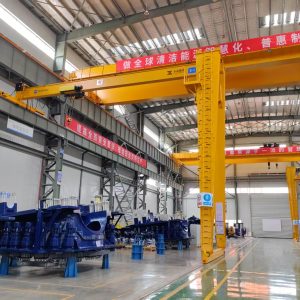
BMG-10T Single Beam Semi Gantry Crane
-
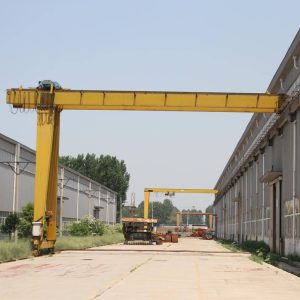
20T Single Girder Semi Gantry Crane – Rail Mounted, A5 Duty
-
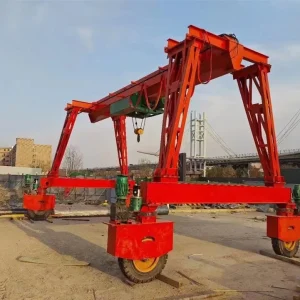
Rubber-Tyred Gantry Crane(RTG)
-
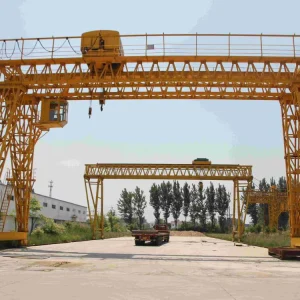
20 Ton Double Girder Gantry Crane – A5-A7
-
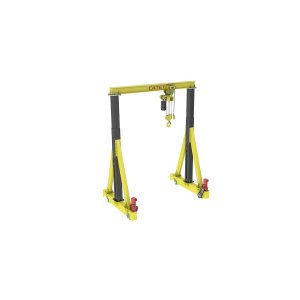
Portable Gantry Crane: Flexible and Efficient Lifting Solution
-
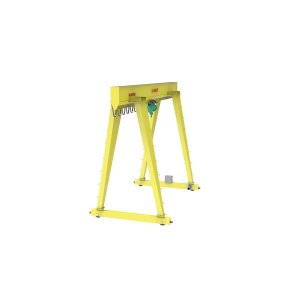
MH Single-Beam Gantry Crane: Cost-Effective Lifting
-
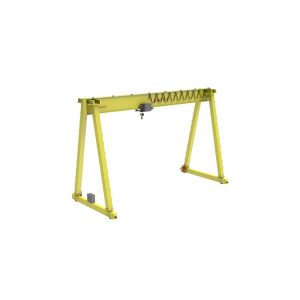
European Single-Beam Gantry Crane: Low-Headroom Lifting
-
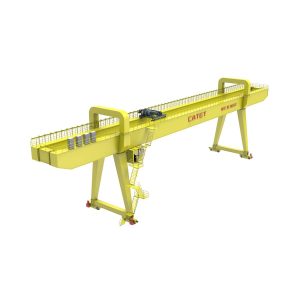
MATE-MG Double-Girder Gantry Crane: Heavy-Duty Lifting
FAQ
Gantry cranes don't require building support structures, making them ideal for outdoor applications, shipyards, and construction sites. They offer flexibility to move materials across large areas and can be relocated as project needs change.
Rail-mounted gantry cranes (RMG) run on fixed tracks providing precise positioning and higher capacity. Rubber-tyred gantry cranes (RTG) offer greater mobility and flexibility, can move freely across paved surfaces, and don't require rail infrastructure.
For operational conditions, we recommend wind resistance up to Beaufort scale 6 (10.8-13.8 m/s). For non-operational parking, our cranes can withstand up to Beaufort scale 12 (hurricane force). We also offer anchoring and anti-typhoon systems for extreme weather areas.
Yes, we offer specialized gantry cranes for extreme environments: low-temperature models (-40°C) for arctic conditions with heated cabins and special lubricants, and high-temperature resistant versions (up to 60°C) with enhanced cooling systems.
Our standard gantry cranes offer spans from 10m to 35m. For special applications, we can design and manufacture cranes with spans exceeding 50m. Span selection depends on your site layout and lifting requirements.
Large gantry cranes are shipped in sections and assembled on-site. We provide detailed assembly drawings, specialized tooling, and experienced installation teams. Smaller portable gantry cranes can be shipped fully assembled.
The ground must be level, compacted, and capable of supporting the crane's wheel loads. For rail-mounted cranes, we require concrete foundations with embedded rails. For rubber-tyred cranes, a reinforced concrete surface is recommended. We provide complete foundation specifications.
Yes, semi-gantry cranes combine overhead crane and gantry crane features. One side runs on elevated rails (building-mounted), while the other runs on ground-level rails, making them ideal for facilities with limited headroom or existing structural constraints.